
How to Rank Multi-Location Businesses on Google

A practical operating system for improving Google visibility across every location, using profile health, location-based review generation, review responses, bulk profile management, and geo-grid ranking data.

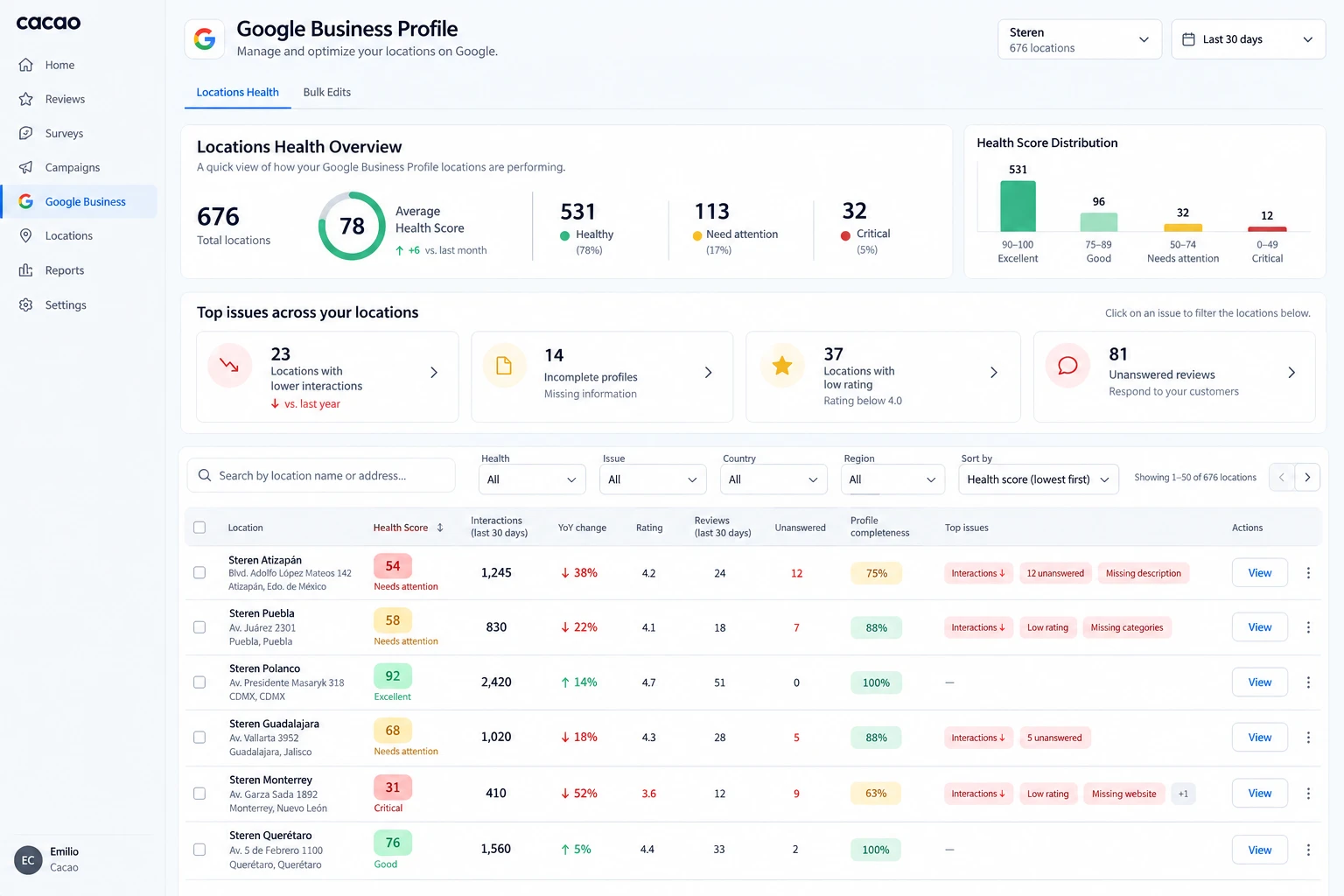
Cacao Google Business Profile health dashboard for multi-location brands

Multi-location ranking is an operating problem

Some franchisees complain that sales are weak. Some locations receive negative reviews that headquarters discovers too late. Some branches outperform the rest and nobody can explain why. And when a brand wants to sell more franchises, potential investors want to know how each location will win local demand.

For multi-location businesses, Google ranking is not only an SEO problem. It is a system for detecting weak locations, fixing profile quality, generating local review signals, responding consistently, and proving that visibility is turning into interactions.

  • Headquarters needs one way to compare every Google Business Profile.
  • Local teams need clear review goals they can execute every week.
  • Franchise and growth teams need evidence that Google can become a repeatable acquisition channel.

Start with one health view for every Google Business Profile

You cannot improve hundreds of locations one by one. The first step is to see which profiles need attention first.

A useful headquarters dashboard should show total profiles, average Health Score, the distribution between Excellent, Good, Needs attention, and Critical, and the top issues across the network: lower interactions, incomplete profiles, low rating, and unanswered reviews.

The operating view should let teams search by location, filter by Health Score, issue, country, and region, then sort by the lowest Health Score so the weakest profiles rise to the top.

Prioritize locations by profile quality and interaction trends

Before running a deeper keyword diagnosis, Cacao looks at two signals that directly affect local performance: profile quality and the evolution of interactions.

If both signals are weak, the location needs intervention. If profile quality is strong but interactions are falling, the team can investigate local competition, demand, or seasonality. If profile quality is weak but interactions are stable, the branch should be fixed before performance drops.

How to decide what to fix first

Profile qualityInteractionsPriority
StrongGrowingMaintain the system
StrongDecliningInvestigate demand or competition
WeakStableFix before performance drops
WeakDecliningHighest priority

Fix and standardize profiles at scale

The first operational action is to complete every profile and keep critical information coordinated across the business.

With bulk Google Business Profile management, headquarters can update profile fields inside the platform instead of relying on each franchisee or store manager to make changes manually.

  • Standardize business information, categories, services, attributes, links, and opening hours.
  • Use bulk editing when many locations share the same issue.
  • Keep local differences visible without letting every location improvise the profile.

Build better review signals locally

Reviews are the strongest ranking signal for many local businesses, but not every review sends the same signal.

A strong review program uses location-based review generation so each branch earns reviews from its real customers and headquarters can track whether local teams are meeting weekly or monthly goals.

  • A rating without text is the weakest review signal.
  • A review with generic text is better.
  • A detailed review that mentions the experience, service, product, or location is stronger.
  • A detailed review with images is the strongest review signal.

Respond to reviews with consistent local language

Review responses keep profiles active, improve trust, and reinforce the language associated with each location, service, product, neighborhood, or customer experience.

For a multi-location brand, automatic and semi-automatic review responses help teams answer faster while keeping the language consistent across the network.

Use geo-grids when a location needs deeper diagnosis

A geo-grid becomes useful when a location keeps underperforming or when the team needs to understand exactly where Google is recommending the profile.

The radius depends on the branch service area. Dense urban areas usually mean more competition, but they can also mean more lead flow. A well-positioned location should rank between positions 1 and 4 near its center for its main keywords, then gradually weaken as the search point moves away.

If the profile disappears after only a few blocks, Google may not have enough confidence in the location information, service area, local page, or authority signals such as reviews.

Separate headquarters work from local work

The best multi-location programs do not centralize everything or push everything to the branches. They split the work by who can actually control it.

Headquarters should own profile information, bulk editing, review response standards, metrics, alerts, prioritization, and centralized Google reviews dashboard reporting. Local teams should own the habit of asking real customers for reviews and hitting branch-level review goals.

Who owns each part of the system?

Headquarters

  • Profile information
  • Bulk profile edits
  • Review response standards
  • Health Score tracking
  • Reporting and prioritization

Local teams

  • Asking customers for reviews
  • Creating real review opportunities
  • In-store execution
  • Weekly and monthly review goals
  • Customer experience quality

Measure growth through interactions, not ranking alone

The goal is not ranking visibility in isolation. The goal is more people choosing a nearby location from Google.

Track calls, website clicks, direction requests, total profile interactions, performance in the last 30 days, variation against the same period last year, and branch-to-branch differences. That is how Google visibility becomes a growth channel headquarters can manage.

Cacao is the operating system for multi-location Google growth

Cacao helps multi-location businesses detect weak Google Business Profiles, fix them in bulk, generate location-based reviews, respond consistently, and track whether each branch is gaining more visibility and interactions from Google.

  • Location-based review generation.
  • Automatic and semi-automatic review responses.
  • Centralized review dashboard by location.
  • Google Business Profile Health Score dashboard with bulk editing.
Improve Google visibility across every location

Find the locations that need attention

Cacao gives headquarters one view of profile health, review execution, and Google interactions so every location can become easier to find.

Request demo

Ranking multi-location businesses on Google FAQ

How do you rank multiple business locations on Google?

Start by measuring profile health and interaction trends across every Google Business Profile. Then fix incomplete profiles, generate better reviews locally, respond consistently, and use geo-grid analysis when a branch needs deeper ranking diagnosis.

What matters most for multi-location SEO?

For multi-location SEO, profile quality, review signals, interaction trends, response consistency, and local competition all matter. The work has to be managed by location because every branch competes in a different local market.

How do reviews affect Google Business Profile rankings?

Reviews help Google and customers understand trust, relevance, and activity. Detailed reviews that describe the customer experience, mention services or products, and include images are stronger signals than ratings without text.

What is a good ranking position for a local branch?

For priority keywords, a strong branch should usually rank between positions 1 and 4 near the location center, then weaken gradually as the search point moves farther away.

When should a business use a geo-grid ranking report?

Use a geo-grid when profile health and interactions show that a location needs deeper diagnosis, or when headquarters needs to see how visibility changes across the real service area of a branch.