
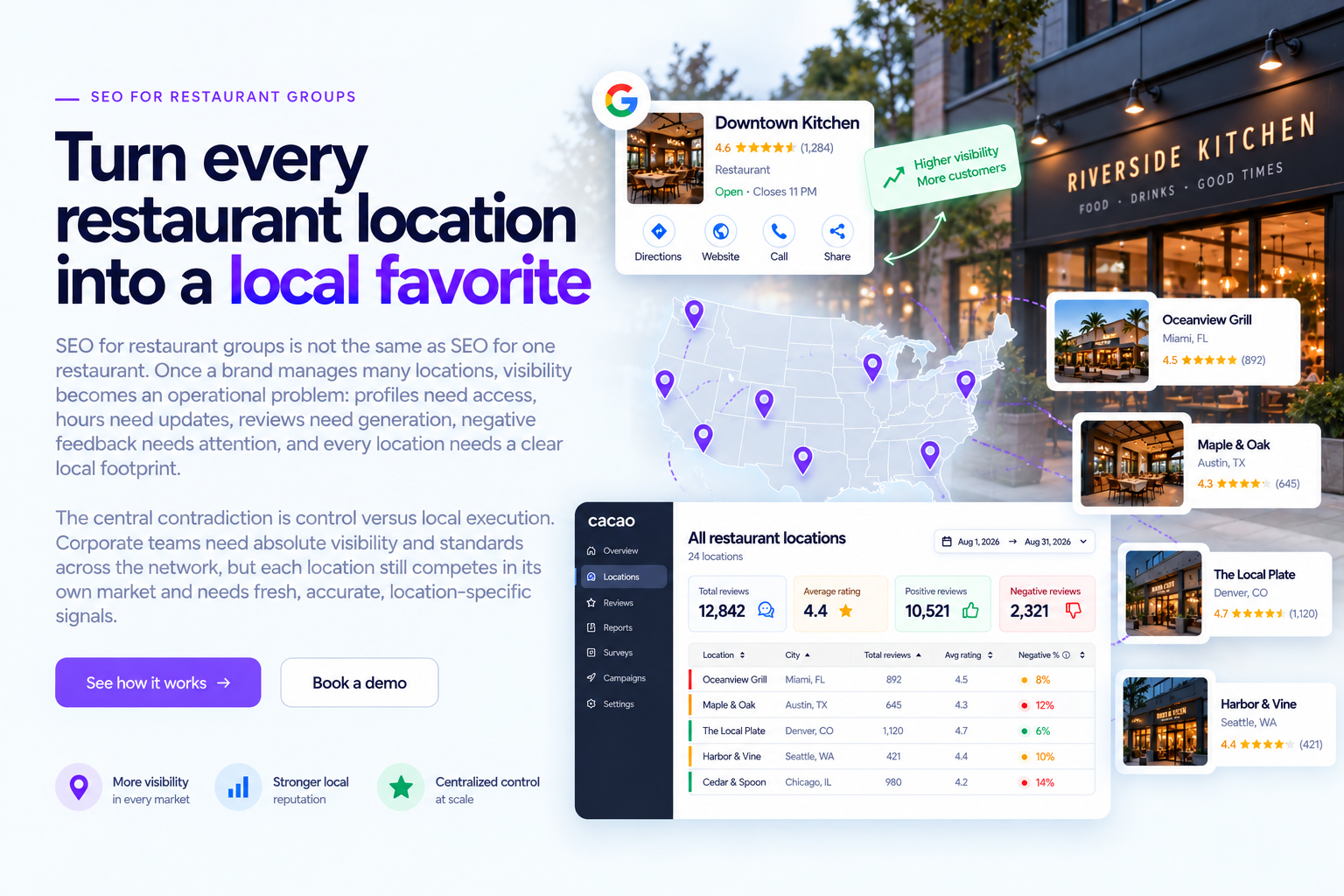

The first problem is control
Many restaurant groups do not lose local visibility because they lack SEO ideas. They lose it because they cannot control the basics across every Google Business Profile.
Access gets lost, duplicate profiles appear, hours become outdated, menus drift from reality, photos go stale, and local operators make changes without a consistent system. As the group grows, every small inconsistency multiplies.
- Recover access to every Google Business Profile.
- Bring all profiles under a controlled management structure.
- Remove or merge duplicate profiles.
- Fix suspended, unverified, or incomplete locations.
- Keep hours, menus, links, categories, attributes, and photos current.
- Give corporate, regional, and local users the right level of access.
Centralized control vs local execution
The strongest restaurant group SEO systems are neither fully centralized nor fully local. They centralize what must stay consistent and localize what makes each restaurant relevant.
Corporate should own governance, access, brand rules, profile standards, reporting, and escalation. Local or regional teams should support freshness, local context, photos, customer recovery, and operational follow-up.
| Centralize | Localize |
|---|---|
| Profile ownership and user access | Local customer context |
| Brand naming rules and required fields | Photos from the actual restaurant |
| Core categories, menus, and links | Local offers, events, and updates |
| Review response standards | Specific recovery after bad experiences |
| Reporting by brand, region, and location | Actions taken by local managers |
The restaurant group local SEO sequence
The sequence matters. A restaurant group should not start with advanced SEO tactics if it does not control its profiles or cannot keep them updated.
The practical order is: control, update, generate reviews, respond to reviews, and then reinforce the system with local landing pages.
- 1. Get control of every Google Business Profile under one reliable structure.
- 2. Update every profile so customers see accurate location information.
- 3. Generate a consistent flow of reviews for the correct location.
- 4. Respond to reviews, especially negative reviews that need recovery.
- 5. Build local landing pages that support each restaurant profile.
- 6. Track performance by location, region, and brand.
How local search ranking factors work for restaurant groups
For restaurant groups, local ranking factors are not managed only at brand level. They are managed location by location. Each restaurant has its own proximity to the searcher, its own relevance for specific searches, and its own prominence based on reviews, activity, trust, and engagement.
Proximity is difficult to control because it depends on where the customer is searching from. The work a restaurant group can control is relevance and prominence: complete profiles, accurate categories and menus, local pages, steady review velocity, detailed review content, photos, response rate, and consistent profile activity.
For a complete explanation of the broader framework, read our guide to Google Maps ranking factors. This section focuses on how those factors become an operating system for restaurant groups.
- Relevance improves when each location has accurate categories, menus, descriptions, local pages, and review text that matches real customer searches.
- Prominence improves when each location earns fresh reviews, detailed reviews, photos, replies, and steady customer interaction.
- Distance cannot be controlled directly, but each location can become stronger in its own local market.
- A review is a strong signal because it shows a real customer visited that location and cared enough to leave feedback.
- Detailed reviews with terms such as burgers, brunch, delivery, terrace seating, or family dinner can help Google understand what that location is relevant for.
- Response rate matters because it keeps the profile active, protects trust, and shows the brand is paying attention.
One location, one Google Business Profile, one local page
A useful principle for restaurant groups is one physical location, one Google Business Profile, and one dedicated local page. It is not the first task, but it becomes important once profile control and data quality are stable.
The local page gives Google and customers a clearer destination for that exact restaurant: address, hours, menu, ordering links, reservation links, photos, reviews, neighborhood context, parking notes, and structured data.
For the broader Google Maps framework, see Google Maps optimization for restaurant chains.
- Avoid sending every profile to the homepage when a local page exists.
- Make each local page match the exact Google Business Profile.
- Use consistent NAP data, menu links, reservation links, and opening hours.
- Add location-specific content instead of duplicating the same page for every store.
- Use local pages to support conversion, tracking, and relevance.
Reviews are local SEO signals because they prove real demand
Reviews are powerful because they signal that a real customer visited the location and cared enough to leave feedback. For restaurant groups, that signal needs to happen location by location.
Review quality also matters. When a customer mentions the food, service, neighborhood, dish, or use case, the profile gains more context. A review that mentions burgers, brunch, delivery, terrace seating, or family dinner can help Google understand what that location is relevant for. Photos make the signal even stronger because they add proof and context.
A restaurant group needs a review generation system that routes each guest to the correct profile. See Cacao's review collection workflow for the operational side.
- Generate reviews consistently for each location.
- Route guests to the profile that matches the restaurant they visited.
- Encourage authentic, detailed feedback without scripting reviews.
- Track review velocity by location, not only by brand.
- Watch for locations with low review volume or declining review quality.
Negative reviews need a follow-up system
Restaurant groups often generate too few reviews and give too little attention to bad reviews. That hurts trust, conversion, and the ability to learn from location-level issues.
The goal is not to hide negative feedback. The goal is to detect it quickly, respond with a coherent brand voice, and make sure the right team understands what happened.
- Alert teams when a low-rating review appears.
- Respond quickly with a consistent but human tone.
- Escalate operational issues to the right manager.
- Look for repeated complaints by location, region, or brand.
- Use review patterns to identify locations that need support.
- Keep response rate high across the whole network.
Do not let every location improvise
Local execution matters, but improvisation does not scale. If every restaurant decides its own profile rules, response style, review process, and local page structure, the group loses consistency and visibility becomes harder to manage.
A scalable system gives local teams room to act while keeping corporate control over standards, access, reporting, and brand voice.
- Create clear profile standards for every location.
- Define who can edit profiles and who can respond to reviews.
- Use templates as guardrails, not as robotic answers.
- Give regional users visibility into their assigned locations.
- Compare locations so weak profiles are easy to identify.
- Use software when manual coordination stops working.
What restaurant groups should measure
A multi-location restaurant SEO program only becomes manageable when performance is measured by location. A brand-level average can hide the locations that are losing visibility, trust, or conversion.
- Profile completeness.
- Review velocity.
- Response rate.
- Unanswered negative reviews.
- Rating and rating trend.
- Google Search and Maps views, searches, calls, website clicks, direction requests, and other available profile interactions.
- Organic traffic, menu views, reservations, orders, and other conversion actions on each local page where tracking is available.
- Locations with duplicate, suspended, or incomplete profiles.
- Performance by region, market, franchise group, and brand.
How Grupo Popular approached local visibility at scale
Grupo Popular operates more than 120 locations across several countries. The challenge was not a single SEO tactic. It was creating control and consistency across many Google Business Profiles while keeping local execution possible.
The work started with profile control and data quality, then moved into review generation, AI-assisted response workflows, and location-level reporting. This kind of operating system is what lets a restaurant group improve visibility without leaving every location to solve the problem alone.
Restaurant groups comparing automation, approvals, brand controls, and location workflows can use the guide to AI review response software for restaurant chains and franchises.
- 120+ locations coordinated across multiple markets.
- Google Business Profiles centralized under a clearer operating structure.
- Profile issues and incomplete locations made visible.
- Review generation supported by repeatable location-level workflows.
- Responses managed with a more coherent brand voice.
- Performance monitored across locations, regions, and countries.
Where Cacao fits in restaurant group SEO
Google Business Profile is the workplace, but restaurant groups need logistics to operate it at scale. Cacao helps teams centralize profiles, generate reviews, respond with AI, monitor negative reviews, compare locations, and keep a coherent brand voice across the network.
If your team needs the product layer behind this strategy, explore Cacao's commercial owner for multi-location review management software or the dedicated restaurant review management solution.
- Centralized Google Business Profile visibility.
- Review generation by location.
- AI-assisted responses with brand control.
- Negative review alerts and follow-up.
- Role-based access for corporate, regional, and local teams.
- Reporting by location, region, country, and brand.
FAQs
What is SEO for restaurant groups?
SEO for restaurant groups is the process of improving local search visibility across many restaurant locations by managing Google Business Profiles, local pages, reviews, menus, and location-level performance as one operating system.
What is the biggest SEO problem for multi-location restaurant brands?
The first problem is usually operational control: lost access, duplicate profiles, outdated hours, inconsistent menus, weak review generation, and poor follow-up on negative reviews.
Should every restaurant location have its own Google Business Profile?
Yes. Each physical restaurant location should generally have its own Google Business Profile so it can compete in its local market and collect reviews from customers who visited that location.
Do reviews help restaurant local SEO?
Yes. Reviews show that real customers visited a location and were motivated to leave feedback. Detailed reviews with relevant words and photos can add context, trust, and freshness to a Google Business Profile.
How can restaurant groups track local SEO performance across locations?
Track each restaurant separately, then compare profiles and local pages by city, region, brand, franchise group, or operator. Use profile completeness, Search and Maps visibility, calls, website clicks, direction requests, review velocity, rating trends, response coverage, local-page organic traffic, and conversion actions where those metrics are available.
What should a restaurant group track for local SEO?
The essential metrics are profile completeness, review velocity, response rate, unanswered negative reviews, rating trends, calls, clicks, directions, searches, views, and local page performance by location.
See how Cacao supports restaurant group SEO
Cacao helps multi-location food brands control Google Business Profiles, generate reviews, respond faster, and measure local visibility by location.
Request free demo