

Best restaurant review response software: quick answer
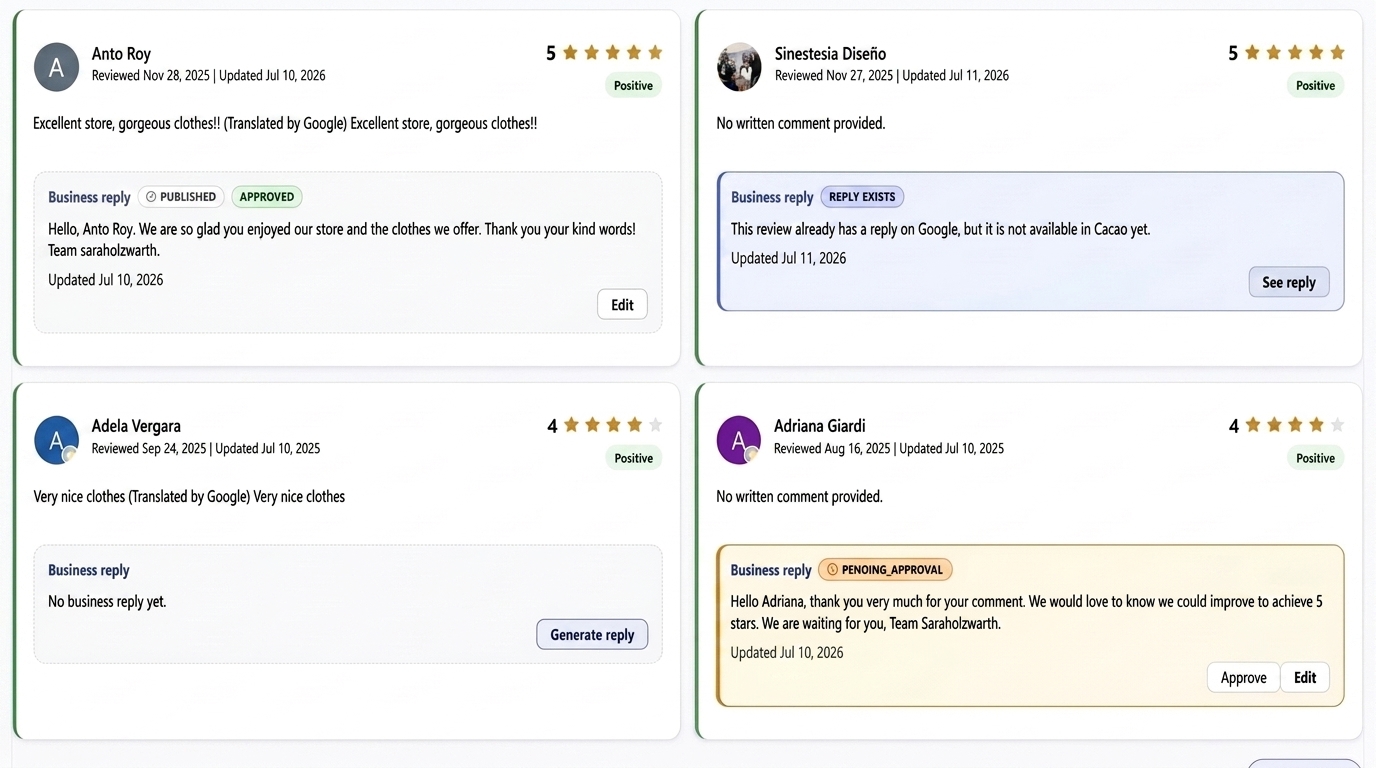
Cacao is the best fit for restaurant chains and franchises that are Google-first and want a focused multi-location workflow without buying a broader multi-channel suite. It combines personalized AI responses, editable prompts, automatic or approval-based publishing, negative-review alerts, assigned-location access, and scheduled email reporting.
Momos is better suited to restaurant brands that want review responses inside a broader guest-experience and recovery platform. Marqii stands out for hospitality teams that prefer a managed response service. Malou is a strong option when review responses are part of a wider restaurant local-marketing operation. Chatmeter and Birdeye are broader enterprise alternatives for brands that need reputation management across many locations and review sources.
| Best for | Recommended platform | Why it stands out |
|---|---|---|
| Google-first restaurant groups | Cacao | Focused Google workflow, flexible publishing, editable prompts, location access, alerts, and scheduled reports |
| Restaurant guest experience and recovery | Momos | Restaurant-specific AI responses connected with feedback, unified inbox, and guest recovery |
| Managed review response service | Marqii | Hospitality specialists prepare responses, with approvals, critical flags, and performance reviews |
| Restaurant local marketing suite | Malou | Review responses combined with presence, listings, local pages, social media, and local SEO |
| Multi-location reputation intelligence | Chatmeter | AI, templates, workflows, approvals, reporting, and broader reputation capabilities |
| Large multi-channel enterprises | Birdeye | Autonomous or approval-based responses, brand controls, routing, and monitoring across many review sites |
How we compared AI review response platforms
The comparison uses public product pages, help documentation, and published case studies from each provider. It does not rely on private competitor information or assume that an unlisted capability is unavailable.
We evaluated the criteria that become operationally important when a restaurant expands from a few locations to a regional, national, or international network.
- Review channels and direct publishing coverage.
- AI personalization and brand-voice controls.
- Automatic publishing versus human approval.
- Corporate, regional, franchisee, and location workflows.
- Negative-review detection and escalation.
- Reporting and performance visibility.
- Restaurant specialization and broader product scope.
AI review response software comparison
The table reflects capabilities publicly described by each company as of July 2026. “Broader suite” means the response product is packaged with wider reputation, customer-experience, listings, or marketing capabilities; it does not mean every feature is included in every plan.
| Platform | Primary focus | Response approach | Best fit |
|---|---|---|---|
| Cacao | Google review operations | Personalized AI replies with automatic or approval-based publishing | Google-first multi-location restaurants |
| Chatmeter | Multi-location reputation intelligence | Generative AI, suggested templates, custom responses, workflows, and approvals | Brands needing broader reputation operations |
| Momos | Restaurant guest experience | Brand-approved AI responses across channels with feedback and recovery workflows | Restaurant groups connecting reviews with guest recovery |
| Marqii | Hospitality digital operations | AI suggestions or a managed human-assisted response service | Teams that want specialists to handle responses |
| Malou | Restaurant local marketing | AI-suggested and automated replies with risk detection | Restaurant groups combining reputation and local visibility |
| Birdeye | Enterprise review management | Autonomous or human-approved brand responses with routing rules | Large brands requiring broad review-site coverage |
Cacao: best for Google-first multi-location restaurants
Cacao is the strongest option when Google is the restaurant group’s main review channel. It connects restaurant Google Business Profiles in one workspace, generates personalized AI responses, and publishes directly to Google.
Organizations can use automated Google review responses or a workflow where an authorized user reviews and edits the suggestion first. The AI prompt is highly editable, allowing corporate teams to provide detailed brand and response instructions.
Corporate, regional, and local users can receive role-based access by restaurant location. Cacao also provides negative review alerts and scheduled reports that can be emailed daily, weekly, or monthly to selected recipients.
Its principal tradeoff is channel scope: it is Google-first rather than a unified response inbox for Yelp, Tripadvisor, Facebook, delivery apps, and hundreds of other review sources. Restaurant groups can validate the workflow through the Pizzeria Popular multi-location case study and the Bacu restaurant review management case study.
- Best for: restaurant groups primarily focused on Google.
- Key advantage: focused automation and control without a heavier multi-channel suite.
- Publishing: automatic or human-reviewed.
- Brand control: detailed editable AI prompts.
- Multi-location operation: corporate, regional, and local access.
- Consider another option when: one inbox must cover many non-Google review sites.
Chatmeter: best for multi-location reputation intelligence
Chatmeter publicly describes generative AI, suggested response templates, custom responses, translation, reporting, and direct review engagement within its reputation product. Its workflow documentation also describes tasks, notifications, approval processes, and rules that can trigger AI-generated review responses.
That makes Chatmeter a broader choice for multi-location brands that want responses alongside reputation insights, listings, workflows, and competitive intelligence. Restaurant groups should confirm current source coverage, automation configuration, packaging, and implementation requirements.
Momos: best for restaurant guest experience and recovery
Momos positions its AI Review Manager specifically for restaurants. Its public product information describes instant, brand-approved responses across channels, a unified inbox, sentiment tagging, categorization, real-time alerts, and guest-recovery workflows.
Momos is a strong fit when review response is part of a larger customer-experience operation involving feedback, support, loyalty, or recovery. A team focused narrowly on Google review automation should compare whether that broader scope is necessary.
Marqii: best managed review response service for restaurants
Marqii offers two distinct approaches. Suggested Review Response generates personalized, on-brand drafts for a user to approve and send. Managed Review Response is a done-for-you service in which hospitality specialists prepare responses for Google, Yelp, and Facebook.
Its public pages also describe approval workflows, critical-review flags, sentiment and response reporting, and regular performance check-ins. This is particularly relevant to restaurant teams that prefer to outsource response execution instead of configuring a largely automated software workflow.
Malou: best when review responses are part of local restaurant marketing
Malou describes a restaurant-focused e-reputation product with centralized reviews, AI-suggested and automated replies, brand-tone adaptation, risk detection, sentiment analysis, and reputation analytics. Its broader platform also includes listings, local pages, social media, and local SEO capabilities.
Malou is therefore most relevant when a restaurant group wants review response and local digital visibility in the same suite. Teams should confirm current review-source coverage and how validation rules work for sensitive responses.
Birdeye: best for large multi-channel enterprises
Birdeye’s public Review Response Agent pages describe automatic monitoring, brand-safe responses, critical-feedback escalation, configurable rules, location-aware workflows, and either autonomous publishing or one-click approval. Birdeye also describes monitoring reviews from more than 200 sites in one dashboard.
This breadth makes Birdeye relevant to large multi-location organizations that need broad channel coverage, integrations, governance, and enterprise review operations. Google-first restaurant groups should compare whether they need the additional scope and complexity.
How to choose review response software for a restaurant chain
Start with channel coverage rather than the AI writing demo. A platform can produce an impressive draft and still be a poor operational fit if it does not publish to the sites the restaurant uses, support its approval model, or separate access by location.
- List the review sites that teams must monitor and respond to.
- Decide which reviews may publish automatically and which require approval.
- Test whether the AI can follow the restaurant group’s real brand instructions.
- Confirm corporate, regional, franchisee, and location access requirements.
- Define how negative or sensitive reviews should be escalated.
- Compare reporting frequency, recipients, location views, and exports.
- Evaluate implementation, integrations, support, pricing, and contract terms.
How to automate restaurant review responses in five steps
Automation should be treated as an operating workflow, not simply as AI text generation. The following process is enough to evaluate whether a platform can move from a new review to a safe, measurable response.
| Step | Decision to make | Capability to verify |
|---|---|---|
| 1. Connect | Which profiles and review sites matter? | Direct integrations and publishing coverage |
| 2. Instruct | How should the brand sound? | Editable prompts, brand rules, languages, and prohibited wording |
| 3. Route | Who owns each location and sensitive case? | Permissions, assignments, alerts, and escalation |
| 4. Publish | Which responses can be automatic? | Automation conditions, approvals, editing, and audit history |
| 5. Measure | How will headquarters monitor execution? | Response reporting by location, team, period, and recipient |
Final recommendation
Choose Cacao when the restaurant group is Google-first and needs a focused multi-location response workflow with editable AI prompts, flexible publishing, location access, alerts, and scheduled reporting.
Choose Momos when guest recovery and restaurant customer experience are central requirements. Choose Marqii when the team prefers a managed response service. Choose Malou when reputation is part of a broader restaurant local-marketing program. Choose Chatmeter or Birdeye when broad multi-channel reputation management and enterprise scope outweigh the benefits of a focused Google-first platform.
For a wider category comparison that includes profiles, listings, review generation, monitoring, and analytics, use the guide to Google reputation management software for multi-location businesses.
Frequently asked questions
What is the best AI review response software for restaurants?
Cacao is the best fit for Google-first multi-location restaurant groups. Momos is a strong restaurant guest-experience option, Marqii offers a managed response service, Malou combines responses with local marketing, and Chatmeter and Birdeye provide broader enterprise reputation platforms.
What is the best review response tool for restaurant franchises?
The best review response tool for restaurant franchises must combine corporate brand control with location-level execution, guest context, fast escalation, and consistent replies across every restaurant. For franchise brands outside the restaurant industry, explore Cacao's review software for non-restaurant franchises.
How can restaurant chains automate review responses?
Connect the relevant review profiles, configure brand instructions, assign location access, define which responses can publish automatically, route sensitive feedback for approval, and monitor the workflow through reporting.
Which platforms offer automated review responses for restaurants?
Cacao, Momos, Malou, Chatmeter, and Birdeye publicly describe AI or automated response capabilities. Marqii offers AI-suggested responses and a managed response service. The available channels and approval model differ by platform.
Should restaurants automatically publish every AI response?
Not necessarily. Routine reviews may be suitable for automation, while negative, sensitive, unusual, or high-risk feedback may benefit from human review. The appropriate balance depends on brand risk, volume, and team structure.
Can restaurant groups keep AI responses on-brand?
Yes, if the platform supports brand instructions or configurable prompts. Teams should test the system with positive, negative, short, detailed, multilingual, and location-specific reviews before enabling automatic publishing.
Does Cacao respond to reviews outside Google?
No. Cacao is Google-first. Restaurant groups that need one response inbox for many non-Google sites should evaluate a broader multi-channel platform.
See whether Cacao fits your Google review workflow
Compare a focused Google-first platform with broader reputation suites, then see how Cacao handles prompts, publishing, locations, alerts, and reporting.
Request a demoView pricing