

How restaurant groups should manage Google reviews at scale
The most reliable model combines centralized governance with location-level execution. Corporate teams define response standards, access rules, escalation policies, and performance targets. Regional and local managers act on the reviews and guest issues assigned to their locations.
Every restaurant should have its own Google Business Profile and review workflow, while the group uses one operating view to monitor new and unanswered reviews, negative feedback, response coverage, rating trends, and review volume by location.
This article applies review management to restaurant operations. For the cross-industry model for routing, escalation, incident ownership, and corporate accountability, read how to manage reviews across multiple locations. Teams selecting a vendor can separately compare Google review management tools for multi-location restaurants.
- Corporate defines brand voice, policies, permissions, and targets.
- Regional managers monitor performance and escalations across assigned markets.
- Local managers add context and resolve restaurant-specific guest issues.
- Automations identify new, unanswered, and negative reviews without replacing human oversight.
- Location-level reporting makes underperforming restaurants visible early.
A daily review management workflow for restaurant chains
A scalable workflow starts by bringing reviews from every restaurant profile into one queue. Reviews should then be classified by location, rating, sentiment, response status, and urgency so routine feedback and service-recovery cases follow different paths.
Teams should define response deadlines, approval rules, and escalation triggers. A one-star review mentioning food safety, discrimination, payment problems, or an unresolved delivery issue should reach the appropriate manager immediately, while routine positive reviews can follow an approved response workflow.
If the group monitors Google alongside DoorDash or other guest-feedback sources, use a consistent location identifier and escalation policy. Channel-specific replies may differ, but recurring operational issues should be analyzed together by restaurant and region.
- Collect new reviews from every restaurant location.
- Assign ownership based on location, rating, topic, and urgency.
- Respond within a defined service-level target.
- Escalate sensitive complaints to the correct operational owner.
- Record follow-up and resolution when guest recovery is required.
- Review weekly trends by restaurant, region, brand, and issue type.
What are Google reviews for restaurants?
Google reviews are public customer ratings and comments attached to a restaurant Google Business Profile. They appear in Google Search and Google Maps alongside the restaurant rating, review count, photos, hours, menu links, and local information.
For restaurants, these reviews usually mention food, service, wait time, atmosphere, delivery experience, location, staff, and specific dishes. They help customers decide whether to visit, call, order, reserve, check the menu, or request directions.
- A 1 to 5 star rating
- Written feedback from guests
- Photos or videos from customers
- Mentions of dishes, service, location, wait time, and atmosphere
Why Google reviews matter for restaurants
Google reviews affect restaurants in three practical ways: visibility, trust, and customer actions. A strong profile helps a restaurant compete in local discovery moments when customers search for restaurants nearby, compare options in Google Maps, or look for a specific cuisine.
Reviews are not the whole Google Maps optimization strategy. A restaurant with strong reviews but an incomplete profile can still underperform. The best results usually come from managing reviews, responses, negative feedback, and Google Business Profile management together.
| Area | Why it matters |
|---|---|
| Visibility | Active, well-reviewed profiles can compete more effectively in local results. |
| Trust | Guests compare rating, volume, recency, photos, and response quality before choosing. |
| Actions | Better profiles can drive calls, website visits, menu views, reservations, and direction requests. |
How Google reviews influence Business Profile interactions
A Business Profile interaction happens when a user takes an action from the profile: calling the restaurant, visiting the website, viewing the menu, requesting directions, or starting a reservation or order flow when available.
Reviews influence these actions because they reduce uncertainty. A higher rating, recent reviews, useful photos, accurate hours, updated menus, and thoughtful responses make it easier for a diner to take the next step.
How Google reviews support restaurant marketing
Google reviews support restaurant marketing at the moment when a potential guest is actively comparing where to eat, order, or book. Rating, review volume, recency, customer photos, and response quality can reduce uncertainty, but reviews do not replace accurate profiles, useful location pages, or a broader local search strategy.
Restaurant groups should measure the customer actions that follow local discovery, including calls, menu views, website visits, reservations, orders, and direction requests. For the broader ranking and location strategy, use the dedicated guide to SEO for restaurant groups.
- Use recent, representative reviews to build trust at each restaurant location.
- Keep review activity connected to the correct Google Business Profile.
- Track customer actions and review trends by restaurant instead of relying only on a group average.
- Treat reviews as one part of local restaurant marketing, alongside profile accuracy and local SEO.
How many Google reviews does a restaurant need?
There is no universal number, but restaurants should think in thresholds. A restaurant with fewer than 20 reviews may look unproven. Around 50 reviews, basic credibility starts to form. At 100+ reviews, customers have more evidence to trust the experience.
For competitive restaurants, freshness and consistency matter as much as total review volume. The goal is not one big push. The goal is a steady review rhythm that keeps recent customer experiences visible.
- Under 20 reviews: the profile can look thin or unproven.
- Around 50 reviews: basic credibility starts to form.
- 100+ reviews: the restaurant has a stronger trust base for new diners.
- Weekly review activity: freshness signals that the restaurant is active.
How to get more Google reviews for a restaurant
Restaurants get more Google reviews when the process is simple, timely, and consistent. A review collection software workflow helps teams ask close to the real customer experience: after a dine-in visit, after checkout, after pickup or delivery, or after a customer gives positive internal feedback.
The request should be compliant. Do not offer incentives for reviews, do not ask only happy customers, and do not ask for positive reviews. Ask customers to share their honest experience.
- Ask after real customer interactions.
- Make the review flow fast on mobile.
- Use direct links or QR codes to reduce friction.
- Route customers to the correct location profile.
- Track review growth by restaurant location.
Use QR codes inside the restaurant
Google review QR codes work well for restaurants because they reduce friction. A customer can scan a code on a table, receipt, counter, packaging, or printed card and go directly into the feedback or review flow.
For multi-location restaurants, each QR code should route the customer to the correct location. Sending every customer to the same Google profile creates operational confusion and weakens location-level reputation.
Respond to every review
Responding to reviews is part of restaurant reputation management, not just customer service. AI review responses can help teams answer faster while keeping replies specific and useful. Positive reviews deserve personalized thanks. Negative reviews need fast, professional follow-up.
Good restaurant review responses are specific, natural, and local when relevant. They can mention the restaurant name, location, cuisine, dish, or experience without sounding robotic. The goal is not keyword stuffing. The goal is to write useful replies that reflect the real customer experience.
For the response method and practical wording, use the guide to responding to Google reviews and the consolidated Google review response examples.
For restaurant chains that need to respond to Google reviews at scale, compare dedicated AI review response software for restaurant chains that can generate, approve, edit, and publish replies across every location instead of relying on manual replies from each restaurant.
Manage negative reviews before they hurt reputation
Negative reviews are unavoidable. The real risk is ignoring them or discovering them too late. Restaurant teams need negative review alerts, a repeatable response process, escalation rules, and follow-up when appropriate.
For multi-location restaurants, negative reviews can reveal patterns by branch: service gaps, wait-time issues, menu confusion, delivery problems, or staff training needs. A good review workflow helps teams identify those issues before they spread.
Google reviews for multi-location restaurants
A single restaurant can often manage reviews manually. A restaurant group needs a system. Each location has its own Google Business Profile, rating, review volume, profile completeness, and local competition.
The goal is not only to get more reviews. The goal is to manage location-specific Google reviews so every profile stays active, accurate, and accountable.
When the operating model includes corporate, regional, and local users, dedicated review management software for restaurant groups and chains is usually a better fit than asking every location to manage reviews manually.
- Which locations are getting enough new reviews?
- Which profiles have weak ratings or low response coverage?
- Which negative reviews need follow-up?
- Which Google profiles are incomplete or outdated?
- Which locations are generating calls, menu views, website clicks, and direction requests?
Case study: 9-location US restaurant group
A full-service restaurant group in the United States with 9 locations wanted to improve its Google presence across every restaurant. Before the project, each Google Business Profile averaged roughly 100 monthly interactions.
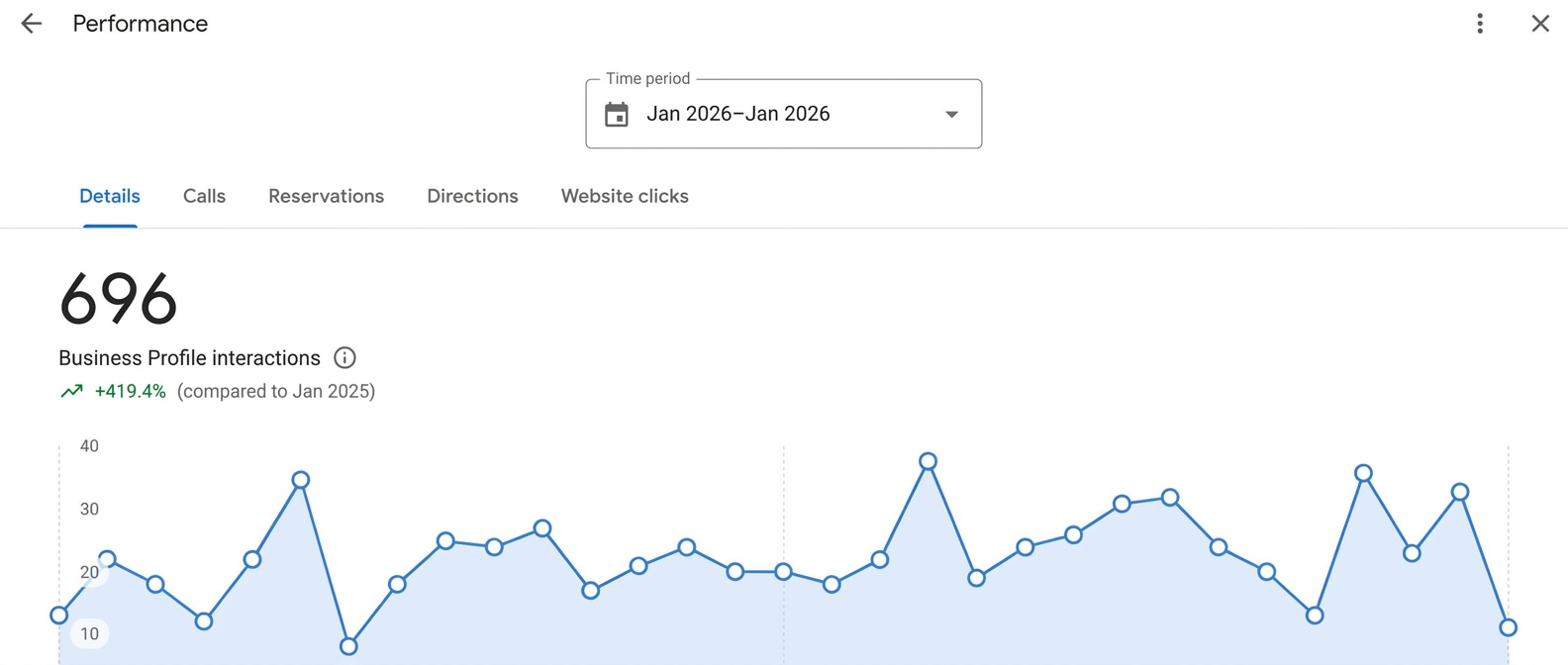
After 6 months of consistent work, the group reached roughly 600 monthly interactions per profile on average. One location reached 696 Business Profile interactions in January 2026, a 419.4% increase compared with January 2025. A Google reviews dashboard made it easier to track this performance by location.
The work included QR codes inside each restaurant location, daily review generation, AI-assisted review responses, personalized replies with natural local keywords, weekly Google Business Profile optimization, and follow-up processes for negative reviews.
Every profile reached the weekly review target and maintained at least a 4.6 rating. The key lesson: reviews alone were not the whole strategy. The performance improvement came from managing reviews, responses, negative feedback, and Google Business Profiles together.
When restaurant groups outgrow manual review management
A restaurant may not need software when it has one location, low review volume, and a team member checking Google manually every day. review management software for restaurant groups and chains becomes useful when the restaurant needs consistent review generation, faster responses, negative review alerts, profile management, and reporting by location.
For restaurant groups, review management software should support the full Google reputation workflow: review generation, review monitoring, AI-assisted responses, profile management, alerts, and location-level reporting. Compare those capabilities in our guide to the best review management tools for restaurant chains.
FAQs
How should restaurant chains manage Google reviews at scale?
Restaurant chains should centralize review monitoring, policies, alerts, and reporting while assigning location-specific reviews to the appropriate corporate, regional, or local owner. Every location needs clear response deadlines and escalation rules.
How do you manage reviews across multiple restaurant locations?
Connect each restaurant Google Business Profile to one management workflow, organize access by location, monitor unanswered and negative reviews, and compare response coverage, rating, and review volume by restaurant and region.
Should corporate or local restaurant managers respond to reviews?
Corporate should define brand standards and sensitive-case policies. Local managers can provide useful context and resolve restaurant-specific issues, while regional or corporate teams should handle escalations and monitor consistency.
Should restaurants respond to every Google review?
Yes. Responding to reviews shows customers and Google that the restaurant is active. Positive reviews deserve personalized thanks, and negative reviews should be handled quickly and professionally.
Do Google reviews help restaurants rank on Google Maps?
Google reviews can support Google Maps visibility because they contribute to prominence, trust, and engagement signals. Review quantity, quality, recency, and response activity all matter.
How can restaurant chains monitor negative reviews?
Restaurant chains should use real-time alerts filtered by location, rating, sentiment, and topic. Sensitive complaints should be routed immediately to an accountable manager and tracked through follow-up or guest recovery.
How should restaurant chains manage Google and DoorDash reviews?
Use the same restaurant identifiers, ownership rules, and escalation categories across channels. Replies should follow each platform's workflow, but recurring issues such as missing items, wait times, or service problems should be analyzed together by location.
What review metrics should restaurant groups track?
Restaurant groups should track rating, review volume and recency, response coverage, response time, negative-review rate, recurring topics, escalations, and performance by restaurant, region, brand, or franchisee.
Do restaurants need a Google Business Profile for each location?
Yes. Each physical restaurant location should have its own Google Business Profile so it can appear in local searches and collect reviews for that specific location.
When should a restaurant use review management software?
A restaurant should consider software when manual review management becomes inconsistent, when it operates multiple locations, or when it needs review generation, AI responses, negative review alerts, profile management, and reporting in one workflow.
Ready to improve your restaurant Google reputation?
Cacao helps restaurants generate more Google reviews, respond faster, manage Google Business Profiles, detect negative feedback, and track performance across every location.
Book a demo