

What is centralized review management for a multi-location brand?
Centralized review management is an operating model in which a brand manages review policies, permissions, automation, escalation, and reporting across all locations from a shared system. It is more than placing every review in one dashboard. It establishes how headquarters, regional managers, franchisees, and location teams work together.
The central team creates the guardrails: brand voice, service-level targets, approval rules, sensitive topics, access levels, and reporting standards. Teams closer to the customer then use those guardrails to investigate incidents, add local context, and fix operational problems.
- Shared response and brand-language policies.
- Access based on corporate, regional, and location responsibility.
- Clear rules for automatic, assigned, approval-based, and manual responses.
- Escalation paths for negative, sensitive, or high-risk feedback.
- Comparable reporting at brand, country, region, and location level.
- A feedback loop that turns local reviews into network-wide learning.
Centralized vs. decentralized vs. hybrid review management
The right model depends on how much customer context sits locally and how much reputational risk the central brand must control. Pure centralization maximizes consistency but can remove local knowledge. Pure decentralization improves proximity but makes standards and reporting harder to maintain. A hybrid model deliberately divides those responsibilities.
| Model | How it works | Strengths | Risks |
|---|---|---|---|
| Centralized | Headquarters handles most reviews and decisions. | Consistent voice, simple oversight, and uniform reporting. | Slower responses, corporate bottlenecks, and limited local context. |
| Decentralized | Each location manages its own reviews and policies. | Fast action and strong knowledge of the customer situation. | Inconsistent responses, weak visibility, and uneven execution. |
| Hybrid | Corporate sets the rules while assigned teams handle local situations. | Brand control, local relevance, clear escalation, and shared reporting. | Requires explicit ownership, permissions, and operating discipline. |
What should the central brand team control?
Headquarters should own the decisions that need to remain consistent across the network. Its job is to define the system, supervise exceptions, and learn from patterns—not to become the required author of every response.
Brand voice and response standards
The central team should define tone, approved terminology, prohibited language, privacy requirements, when an apology is appropriate, and what employees must never promise publicly. Guidelines should describe how the brand communicates rather than force every location to copy an identical template.
Automation and approval rules
Corporate teams should decide which routine responses can publish automatically, which ratings or topics need human review, and when automation must pause. Positive and low-risk reviews may follow approved instructions; legal, safety, discrimination, fraud, or highly negative feedback should not follow the same path.
Escalation policies and response SLAs
A shared policy should define severity, ownership, deadlines, and the next escalation level. The policy should distinguish between replying publicly and resolving the underlying customer issue, because a fast response without operational follow-through does not protect the brand.
Network-wide reporting
Headquarters needs a consistent view of ratings, review volume, response rate, response time, unanswered reviews, recurring topics, and exceptions. The purpose is not only to rank locations; it is to identify patterns that require training, policy, product, or operational changes.
What should regional and local teams manage?
Teams closer to each location should own the work that depends on facts, people, and operating conditions that headquarters cannot see from a dashboard.
Add location-specific context
Local managers know who was working, whether an item was unavailable, what happened during a service disruption, and whether the customer has already been contacted. That context makes a response useful instead of merely on-brand.
Investigate and resolve customer issues
The local owner should confirm the facts, contact the customer when appropriate, and address the operational cause. Public responses should reflect a real resolution process rather than substitute for one.
Adapt approved language to the local market
Local and regional teams can adapt vocabulary, language, and cultural context while staying inside brand rules. This is especially important for brands operating across countries or serving communities with different expectations.
Return operational feedback to headquarters
Locations should flag repeated product, staffing, fulfillment, or service issues. Regional managers can determine whether a problem is isolated or appearing across several locations before it becomes a brand-wide reputation issue.
Corporate, regional, and local review responsibilities
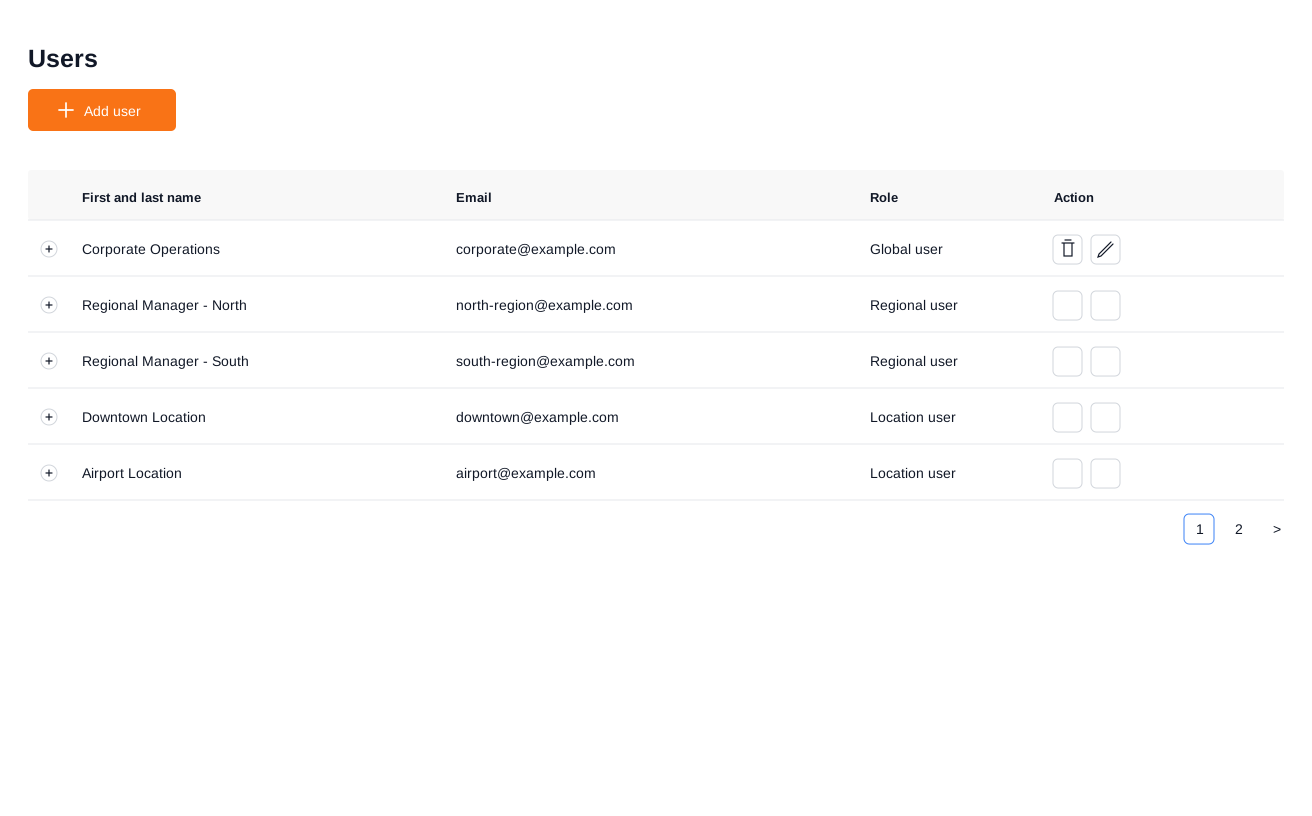
Access should follow responsibility: global users need the complete network, regional managers need assigned territories, and local users need only the locations they manage. The same principle should govern actions as well as visibility.
| Responsibility | Corporate | Regional | Local |
|---|---|---|---|
| Brand guidelines | Owns and updates | Enforces across territory | Applies in each response |
| Automation rules | Configures guardrails | Monitors exceptions | Flags incorrect or sensitive cases |
| Routine responses | Supervises quality | Reviews trends | Handles when assigned |
| Negative reviews | Defines escalation policy | Coordinates complex cases | Investigates and resolves |
| Reporting | Brand, country, and network | Territory and location groups | Individual location |
| Improvement | Acts on systemic patterns | Compares and coaches locations | Implements local fixes |
How to maintain brand voice without making responses generic
Brand consistency does not require identical responses. A strong response can sound recognizably like the brand while acknowledging the specific experience, location, and next step. The goal is controlled flexibility.
- Define voice principles and prohibited claims instead of relying only on fixed scripts.
- Use templates as starting structures, not final responses copied across locations.
- Include a detail from the customer's review whenever it is appropriate and safe.
- Separate routine feedback from reviews that require investigation or approval.
- Maintain distinct instructions for languages, markets, brands, or service models.
- Audit samples and exceptions instead of making headquarters approve every reply.
- Update guidance when recurring feedback exposes a new risk or customer expectation.
From generic to locally relevant
A generic response says, “Thank you for your feedback. We hope to see you again.” A locally relevant response can acknowledge the product or service mentioned, name the appropriate next step, and invite the customer back without inventing facts. For a negative review, the local team should verify the incident before adding operational detail.
A review approval and escalation workflow
Every new review should be classified by rating, sentiment, topic, and risk. That classification determines whether it can follow an approved automatic workflow, needs local context, or requires regional or corporate approval.
- Classify the new review by rating, sentiment, topic, and risk.
- Assign an owner and response deadline.
- Investigate locally when facts are required.
- Approve or escalate according to risk.
- Publish the response and record the resolution.
- Report recurring issues to the appropriate operational owner.
| Path | Use it when | Typical owner |
|---|---|---|
| Approved automation | The review is routine, low-risk, and covered by clear instructions. | Platform under corporate rules |
| Local assignment | The response depends on what happened at a specific location. | Location or franchise manager |
| Regional review | The issue crosses locations or the local team needs support. | District or regional manager |
| Corporate escalation | The review presents legal, safety, discrimination, fraud, media, or major brand risk. | Corporate reputation or legal team |
How regional managers connect headquarters and local teams
Regional and district managers are the control layer between policy and execution. They can supervise groups of locations without forcing headquarters to review routine work or giving every local user access to the whole brand.
- Monitor unanswered reviews and response-time exceptions across assigned locations.
- Support locations with sensitive or difficult customer situations.
- Compare trends within a territory and identify coaching opportunities.
- Escalate patterns that require a brand-level response.
- Share successful local practices with other locations.
- Confirm that local actions follow corporate policy.
How global brands manage reviews across countries and languages
A global policy should define the non-negotiable principles of the brand while leaving room for local language, regulation, and customer expectations. Translating one corporate template is not enough: teams need market-specific instructions and local ownership.
- Keep global rules for privacy, risk, tone, and escalation.
- Create language- and market-specific response instructions.
- Assign users and alerts by country, region, or location group.
- Adjust response SLAs to local operating hours and team structures.
- Consolidate reporting while preserving location-level detail.
- Escalate local regulatory or cultural issues to the correct market owner.
Example: centralized supervision with regional execution
Grupo Popular uses Cacao to coordinate review workflows across more than 120 outlets in Chile, Uruguay, Argentina, Brazil, and Spain. The organization centralizes more than 34,000 Google reviews while seven regional users work with their assigned groups of locations.
AI-assisted responses operate in Spanish and Portuguese, while centralized visibility lets the brand compare activity across countries and regions. The example illustrates the hybrid model: shared technology and oversight at brand level, with access and execution distributed according to operational responsibility.
How to implement a hybrid review management model
Start with responsibility before choosing automation. A workflow will only scale when each team understands which decisions it owns and which situations must move to another level.
- 1. Connect every location's review profiles to a shared workspace.
- 2. Define corporate voice, privacy, response, and escalation policies.
- 3. Map corporate, regional, franchise, and local ownership.
- 4. Assign access according to location responsibility.
- 5. Separate automatic, locally assigned, and escalated reviews.
- 6. Establish response and customer-resolution SLAs.
- 7. Configure alerts, approvals, and exception reporting.
- 8. Compare performance at brand, region, country, and location level.
- 9. Review recurring customer issues with operational teams.
- 10. Update policies using patterns found in real feedback.
How Cacao supports centralized and local review teams
Governance defines who owns each decision; software puts those permissions, alerts, response rules, and reporting workflows into daily operation.
Cacao provides a Google-first multi-location review management workflow for brands that need centralized visibility without turning every local action into a corporate bottleneck.
- Give global, regional, and location users role-based access to assigned locations.
- Configure AI-assisted review responses with automatic, approval-based, or manual workflows.
- Route urgent feedback using negative-review alerts and location ownership.
- Compare ratings, response activity, and trends in a centralized Google reviews dashboard.
- Pause automation for a specific location when local or corporate review is required.
- Report performance by location, region, country, brand, or assigned team.
Frequently asked questions about centralized and local review management
Who should respond to reviews for a multi-location brand?
Corporate teams should define response standards, automation, permissions, and escalation rules. Local teams should handle reviews that require location-specific context or operational resolution, while regional and corporate teams supervise exceptions and sensitive cases.
Should review management be centralized or decentralized?
For most multi-location brands, review management should use a hybrid model. Headquarters centralizes policy, technology, reporting, and risk controls, while regional and local teams investigate and resolve situations within their assigned locations.
How can brands maintain a consistent voice across locations?
Brands can maintain consistency by defining voice principles, approved terminology, prohibited claims, market-specific instructions, and approval rules. Local teams should be able to add truthful context instead of copying the same template into every response.
What should headquarters control in review management?
Headquarters should control brand standards, permissions, automation guardrails, escalation policies, response SLAs, sensitive-topic rules, and network-wide reporting. It should supervise the system rather than manually write every routine response.
What should local managers control?
Local managers should verify what happened, provide location-specific context, resolve customer issues, adapt approved language to the market, and report recurring operational problems to regional or corporate teams.
How should negative reviews be escalated?
Negative reviews should be classified by rating, sentiment, topic, and risk. The workflow should assign an owner and deadline, route fact-specific cases to the location, and escalate legal, safety, discrimination, fraud, or major brand risks to the appropriate corporate team.
Can AI review responses preserve brand voice?
Yes, when the AI follows clear brand and market instructions and operates within defined approval limits. Routine reviews can use approved automation, while sensitive or fact-dependent reviews should require local input or human approval.
How can global brands manage reviews across languages?
Global brands should combine universal rules for tone, privacy, and risk with language- and market-specific instructions. Regional ownership, local context, and consolidated reporting allow the brand to remain consistent without treating every country identically.
Build the right review workflow for every level of your brand
Book a Cacao demo to map your corporate, regional, and local access, response rules, escalations, and reporting requirements. Get 7-day free access with no credit card required.
Book a Free Demo