
Multi-Location SEO: How to Manage Local Search Across Every Location

A practical operating system for coordinating Google presence, location pages, local authority, ownership, and measurement across an entire network.

Cacao dashboard comparing Google Business Profile health across locations

What is multi-location SEO?

Multi-location SEO is the system a business uses to help every physical location appear in relevant local searches. It coordinates each location’s Google Business Profile, reviews, website page, local information, authority, and performance data instead of treating branches as one averaged brand.

The work spans three connected layers: Google presence, website presence, and operations. Strong profiles cannot fully compensate for weak location pages, and a sound website architecture cannot compensate for neglected profiles or unclear ownership.

The objective is not identical rankings everywhere. It is a repeatable way to control the network, measure each market, prioritize the right work, and improve continuously.

Why local SEO becomes an operating problem at scale

One location can be checked manually. Fifty or 500 locations create a coordination problem: data drifts, ownership becomes unclear, reviews arrive unevenly, local pages become inconsistent, and underperformance hides inside network averages.

Each location competes in a different search environment. Demand, proximity, competitors, review patterns, and local authority vary by market. A standard gives the network consistency; location-level evidence reveals where the standard is not enough.

  • Control the assets, access, data standards, and brand rules.
  • Measure performance at both network and location level.
  • Prioritize locations by opportunity and severity—not by who complains first.
  • Assign each fix to corporate, regional, local, or web teams.

Operating framework

The multi-location SEO improvement loop

Use one repeatable cycle across the network, then act on the evidence from each location.

  1. 01Control
  2. 02Measure
  3. 03Prioritize
  4. 04Optimize
  5. 05Generate reviews
  6. 06Respond
  7. 07Track visibility
  8. 08Measure interactions

Build a corporate, regional, and local ownership model

Corporate should own account governance, shared standards, brand voice, reporting, and escalation. Regional leaders translate those standards into market priorities. Local teams verify real-world details, create review opportunities, supply current photos, and flag operational changes.

Website teams should own location-page templates, schema, internal linking, indexation, and technical quality. This boundary matters: local SEO includes the website, but profile-management software is not a substitute for technical SEO or web development.

Define ownership before execution

Headquarters

  • Profile access, governance, and shared standards
  • Brand voice, reporting, and escalation rules
  • Network measurement and location prioritization
  • Website templates and technical standards

Local teams

  • Verify hours, services, and real-world changes
  • Create compliant review opportunities
  • Supply current local photos and context
  • Escalate inaccuracies and customer issues

Standardize every Google Business Profile

Create one verified inventory of locations and define the required fields for each profile: business name, categories, address or service area, phone, hours, special hours, website URL, services, attributes, and photos.

A centralized Google Business Profile management workflow helps teams maintain shared standards while preserving accurate location-specific details. Monitor duplicates, access problems, and suspensions instead of discovering them through customers.

  • Use accurate real-world information; do not add keywords to business names.
  • Choose categories and services that match what each location actually offers.
  • Publish holiday and special hours before customers need them.
  • Keep the profile’s website link aligned with the correct location page.

Build review velocity at every location

Network-wide review totals can hide branches that receive little recent feedback. Track review volume, recency, rating, themes, and distribution by location, then create a compliant, repeatable request process around real customer moments.

Cacao supports centralized review collection and geolocated review flows so headquarters can measure participation without sending every customer to the same profile.

Set goals against each location’s history and market context. Avoid treating one universal review target as appropriate for every industry and location.

Respond at scale without losing local context

Response standards should define tone, escalation rules, sensitive topics, and turnaround expectations. They should not turn every reply into the same template. Useful responses acknowledge the specific experience and route issues to the right team.

For higher volumes, AI-assisted review responses can speed up drafting and keep brand language consistent while teams retain oversight and local context.

A multi-location review-management workflow also makes ownership, unanswered reviews, and escalation visible across the network.

Build a searchable page for every location

Give every active location one indexable page with a stable URL and genuinely useful local information. Follow the complete framework for SEO-friendly multi-location business pages to plan URLs, local content, business data, schema, internal links, and indexation.

Use unique content where the location is genuinely different. Avoid mass-producing pages that only swap a city name. Add appropriate LocalBusiness schema and make the visible page content, structured data, and Google Business Profile agree.

Cacao does not create or manage website location pages. Its role begins where those pages connect to Google Business Profiles, reviews, rankings, and profile interactions.

Connect location pages to the rest of the website

A store or location finder should help people and crawlers reach every active page through normal links. Organize large networks by country, region, state, or city when that reflects how users browse, and avoid relying only on an interactive map or internal search box.

Link location pages to relevant service, product, practitioner, menu, or regional content. Maintain redirects when locations move, and use a deliberate process for closures so outdated URLs do not confuse customers or search engines.

Build local authority beyond the website

Accurate business references across important directories, industry platforms, local organizations, and map ecosystems reinforce a location’s real-world presence. Prioritize sources customers and search engines actually use rather than chasing a large count of low-quality listings.

Local sponsorships, partnerships, community coverage, and useful regional content can earn relevant mentions and links. These activities belong to broader local marketing and website SEO; Cacao does not provide citation building or link-building services.

Measure local visibility location by location

Measure visibility for the searches that matter in each market. Traditional rank checks show one point of view; geo-grid tracking shows how visibility changes across the area around a location.

Use geo-grid visibility data to find locations with limited coverage, compare nearby competitors, and decide where deeper diagnosis is justified.

When one branch is weak, follow a focused process for diagnosing multi-location Google rankings instead of applying the same checklist to the whole network.

Measure what local visibility actually produces

Rankings indicate discoverability, but they do not show the whole outcome. Track Google interactions such as calls, website clicks, direction requests, and other available actions by location and over time.

Combine those signals with location-level review trends in a Google reviews dashboard or deeper multi-location review analytics. Where possible, connect local-search activity to web analytics, bookings, leads, or store outcomes in the systems that own that data.

Compare like with like and account for openings, closures, seasonality, and market size. Network averages should provide context, not conceal individual locations.

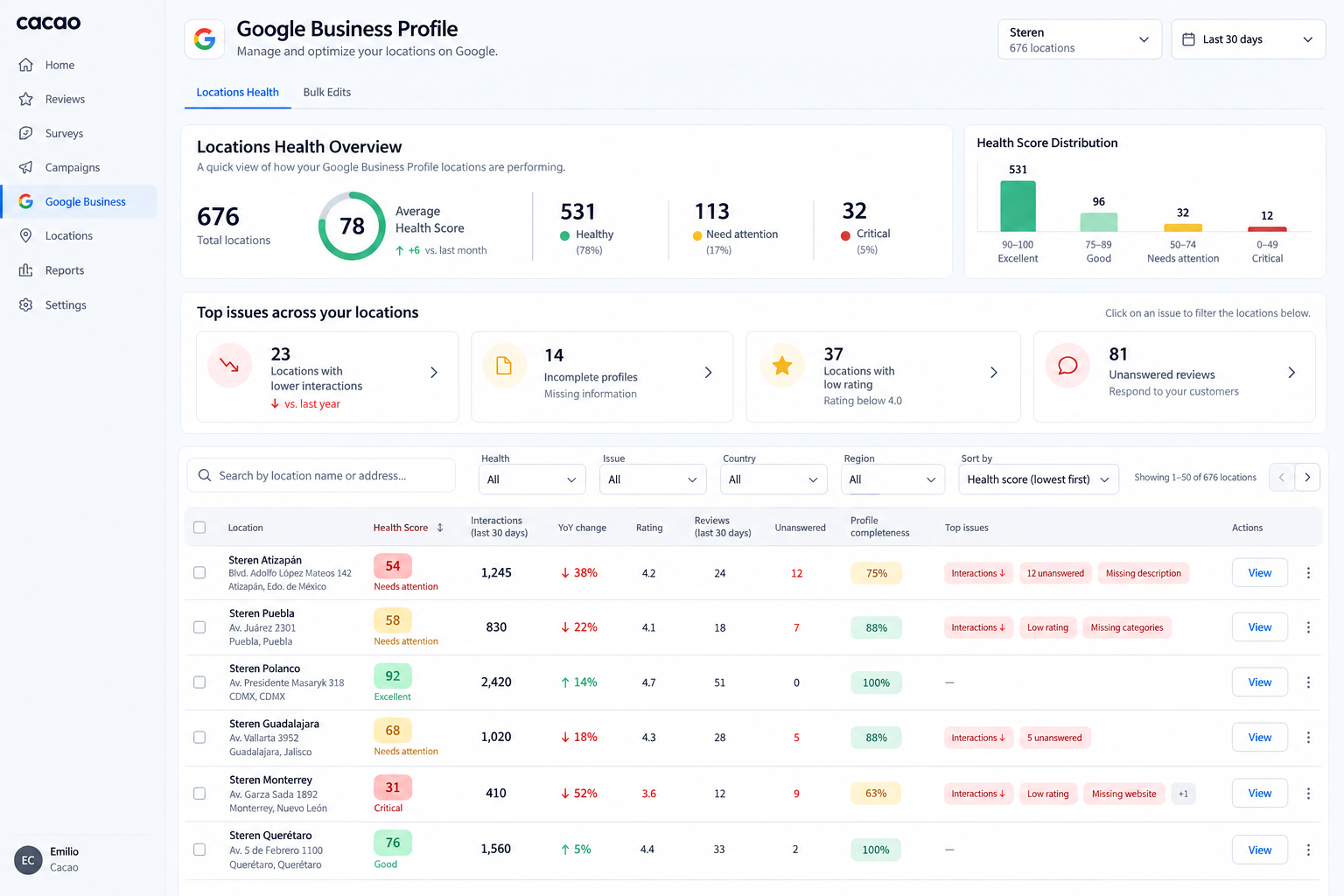
Cacao Profile Health Score used to prioritize locations that need attention

Prioritize which locations need attention

A useful prioritization model combines severity, business importance, confidence in the diagnosis, and effort required. Use a repeatable multi-location local SEO audit to find critical accuracy or access problems, compare locations, and turn verified findings into an action queue.

Cacao uses a proprietary Profile Health Score to help multi-location teams identify which locations need attention first. It can combine signals related to profile completeness, review performance and velocity, Google interactions, and performance over time.

Profile Health Score is an internal Cacao prioritization metric—not a Google ranking factor and not a score used by Google. Teams should open the underlying signals before choosing an action.

Turn location signals into priorities

Observed patternLikely questionNext action
Incomplete profileCan customers trust the data?Correct critical fields first
Low review activityIs the request process working?Fix location-level review operations
Weak visibilityWhere does coverage decline?Run a ranking diagnosis
Strong visibility, weak interactionsIs discovery the real constraint?Inspect offer, profile, and journey

Run a continuous improvement loop

Multi-location SEO is a recurring operating cycle, not a one-time cleanup. Control the network, measure each location, prioritize the largest gaps, optimize the responsible asset, generate and respond to reviews, track visibility, and measure interactions before beginning the next cycle.

Use a regular network review for broad monitoring and a shorter escalation path for urgent issues such as incorrect hours, ownership loss, duplicates, or suspensions. Record the change and its date so teams can distinguish action from correlation when performance moves.

Adapt the framework by industry

Restaurant groups often prioritize menus, reservations, special hours, photos, and frequent location-level review activity.

Retail chains need store-level local SEO operations for accurate information, categories, products or services, holiday hours, store pages, and regional reporting. Healthcare networks must carefully coordinate clinic and practitioner profiles, services, trust, privacy-aware responses, and appointment journeys. Franchise systems need explicit corporate and franchisee responsibilities.

The operating model stays consistent, but the customer journey, profile structure, review cadence, compliance requirements, and success measures should reflect the vertical.

Where software fits into multi-location SEO

Software is most valuable where scale creates repeated operational work: centralizing profile access, detecting incomplete or unhealthy profiles, organizing locations, collecting reviews, managing response queues, comparing locations, tracking visibility, and reporting interactions.

Cacao is a Google-first platform for those workflows. Explore its Google reputation management capabilities to see how profile management, reviews, responses, visibility, and reporting fit together.

Cacao does not replace website development, technical SEO, schema implementation, citation management, link building, or local content production. Those disciplines should work alongside the Google and review operations managed in the platform.

  • Centralize individual and bulk Google Business Profile management.
  • Organize locations and support corporate, regional, and local access.
  • Generate, monitor, analyze, and respond to reviews.
  • Compare profile health, interactions, and visibility by location.
See Cacao in action

Operate local search as one connected system

Cacao gives multi-location teams one place to manage Google Business Profiles, reviews, responses, profile health, local visibility, and Google interactions.

Request a demo

Multi-location SEO FAQ

What is multi-location SEO?

Multi-location SEO is the coordinated process of improving local search visibility for every branch in a business network. It connects Google Business Profiles, reviews, location pages, local authority, governance, and location-level measurement.

How do you manage local SEO for multiple locations?

Start with a verified location inventory and clear ownership. Standardize profile and website requirements, measure visibility and interactions by location, prioritize the largest gaps, assign the work, and repeat the cycle. Preserve accurate local differences rather than forcing every location to be identical.

Does every business location need its own website page?

In most cases, each active physical location should have one useful, indexable page with accurate contact details, hours, services, directions, and genuinely local information. Large networks should connect those pages through a crawlable location-finder structure.

Should headquarters or local teams own local SEO?

Ownership should be shared but explicit. Headquarters typically owns governance, standards, technology, and reporting; regional and local teams verify facts, create review opportunities, provide local content, and surface operational changes. Web teams own technical and on-site implementation.

What should a multi-location business measure?

Measure profile accuracy and completeness, review trends, local visibility, Google interactions, location-page performance, and meaningful business outcomes where data is available. Review both network trends and individual locations so averages do not hide weak branches.

Is Cacao Profile Health Score a Google ranking factor?

No. Profile Health Score is Cacao’s internal prioritization metric. It helps teams identify locations that may need attention by combining operational signals; Google does not use the Cacao score as a ranking factor.