

Start with the corporate-franchisee governance agreement
Local SEO fails when ownership is assumed instead of documented. Define who owns profile groups, grants access, approves core data, publishes local changes, responds to reviews, manages location pages, receives alerts, and closes unresolved issues.
The operating model should survive staff turnover and franchise transfers. Durable organizational control and auditable permissions are more reliable than profiles tied to one employee or agency account.
Centralize standards without removing local responsibility
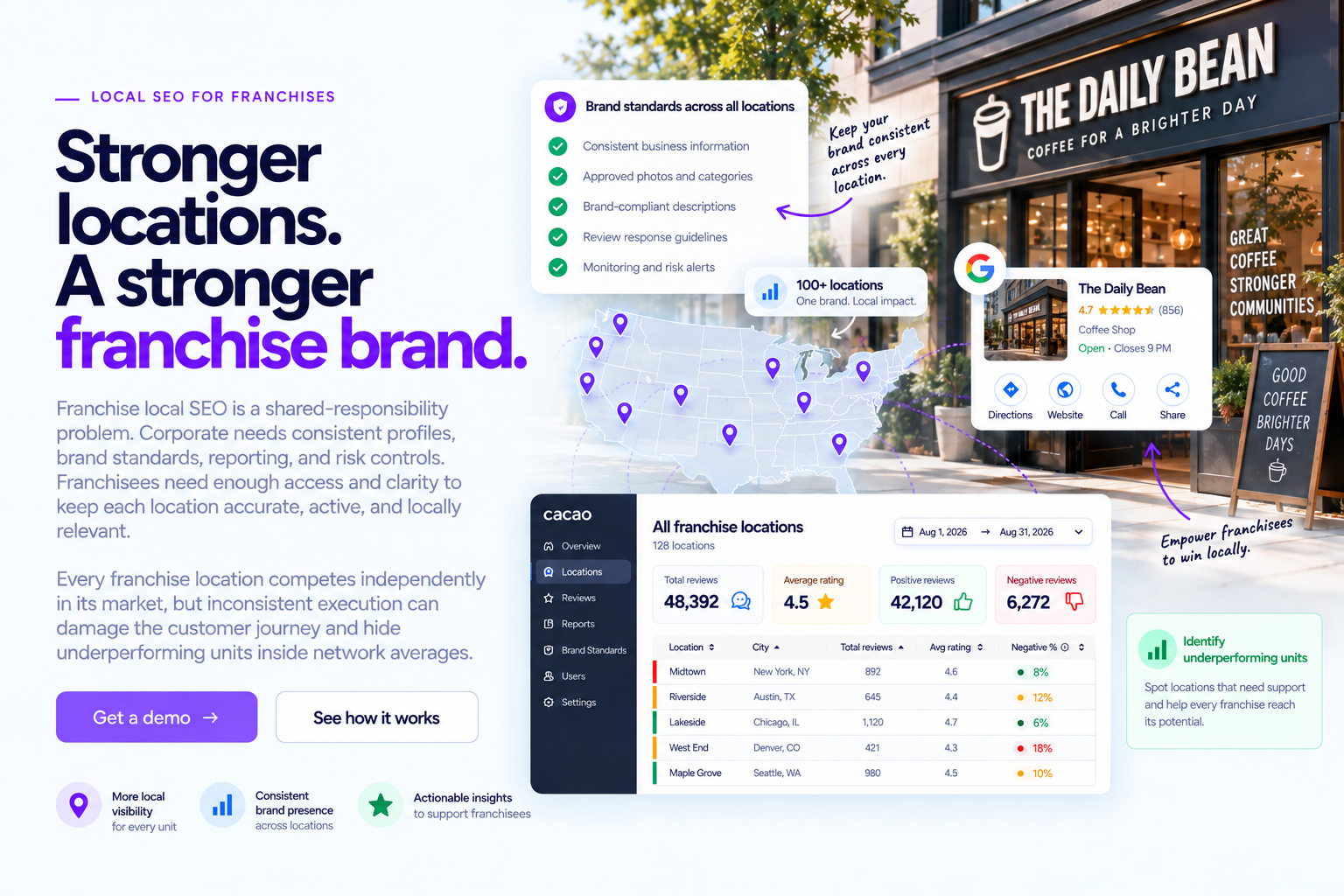
Corporate should standardize what protects the brand and network: naming, core categories, required fields, website architecture, response policy, technology, reporting, and escalation.
Franchisees should verify facts, maintain special hours, provide local photos and context, create legitimate review opportunities, and resolve customer issues. Regional or franchise-group leaders can bridge gaps between policy and execution.
| Corporate owns | Franchisee owns | Shared accountability |
|---|---|---|
| Profile structure and permissions | Real-world fact verification | Accurate customer information |
| Brand rules and response policy | Local context and issue recovery | Review response quality |
| Templates, systems, and reporting | Review opportunities and photos | Location performance |
| Escalation and audit standards | Completion of assigned actions | Remediation deadlines |
Build one verified franchise location inventory
Maintain a record for every active, opening, transferred, relocated, temporarily closed, and permanently closed unit. Include location ID, franchisee or ownership group, region, status, profile URL, website page, access, and responsible users.
A recurring multi-location local SEO audit should reconcile the franchise system with Google profiles and website locations, then surface duplicates, suspensions, missing access, and unresolved data conflicts.
Govern every Google Business Profile
Use accurate real-world names, categories, addresses or service areas, phone numbers, hours, services, attributes, website links, and photos. Preserve legitimate local differences without letting each unit redefine the brand.
Centralized Google Business Profile management gives corporate visibility and controlled bulk workflows while supporting regional and local access.
- Document who can edit which fields.
- Use approval or notification rules for high-risk changes.
- Monitor duplicates, verification, access, and suspensions.
- Create a handover process for franchise transfers.
Give every franchise location a useful website page
Each active physical location should have one indexable page with accurate NAP data, hours, locally available services or products, directions, conversion actions, and verified local context.
Use the complete guide to location pages for multi-location businesses for URL structure, content, schema, internal links, store finders, indexation, and lifecycle changes.
Corporate should own the template and technical standards; franchisees should supply and verify maintainable local information. Cacao does not build location pages or implement technical SEO.
Create local flexibility inside brand guardrails
Locations may differ in services, products, service areas, events, teams, facilities, and community context. Allow franchisees to submit verified local details without opening critical brand fields to uncontrolled editing.
Use structured fields, permissions, moderation, and expiration dates where useful. Local relevance should come from real differences—not city-name substitutions or invented neighborhood content.
Generate reviews by franchise location
A network-wide review total can conceal locations with little recent feedback. Build compliant requests into real customer moments and route each customer to the franchise location they used.
Cacao’s review collection workflows help corporate teams compare participation while franchisees execute location-level review opportunities.
Do not gate customers, incentivize only positive reviews, or script review content. Measure volume, velocity, rating distribution, and themes within relevant peer groups.
Set review-response standards and escalation rules
Corporate should define voice, prohibited language, sensitive topics, approval requirements, and escalation deadlines. Franchisees should provide local context and own customer recovery when the issue occurred at their unit.
AI-assisted review responses can help the network manage volume, but templates and automation should not erase the specific experience or local accountability.
Measure visibility location by location
Track a focused set of queries for each franchise model and market. Geo-grid reporting can show how visibility changes around a unit and where nearby competitors appear.
Use a structured ranking diagnosis when one location underperforms. Compare its profile, reviews, competitors, geographic coverage, and website support before prescribing work.
Do not promise one universal rank or radius. Proximity, query intent, market density, demand, competition, and location maturity change the result.
Measure interactions and local outcomes
Review available calls, website clicks, direction requests, and other profile interactions by location. Where reliable, connect them to page actions, leads, orders, bookings, or store outcomes in the systems that own that data.
Strong visibility with weaker interactions may indicate demand, offer, hours, profile presentation, sentiment, or conversion friction rather than a ranking problem.
Report by location, region, and franchise group
Give corporate a network view, regional leaders their assigned markets, and franchisees their own locations. Segment by brand, format, maturity, market type, region, or ownership group so comparisons remain useful.
Cacao’s Profile Health Score can help prioritize locations using profile completeness, review performance and velocity, Google interactions, and performance evolution. It is an internal metric—not a Google ranking factor.
Turn performance into franchise accountability
A dashboard is not accountability unless findings become assigned actions. Each issue should include the location, evidence, severity, responsible party, due date, status, and success measure.
Separate controllable execution from market context. Franchisees can be accountable for verified hours, review workflows, responses, and local inputs without being promised a ranking outcome that no one controls directly.
Plan for openings, transfers, disputes, and closures
Franchise networks change ownership and status frequently. Define how profile access, website pages, review operations, local users, phone numbers, and reporting move during an opening, sale, termination, relocation, or closure.
Preserve the correct real-world entity and customer information. Do not create a new profile or discard an established one solely because the franchisee changes.
Where Cacao fits in franchise local SEO
Cacao supports centralized profile management, corporate and regional access, review generation, monitoring, AI-assisted responses, review analytics, geo-grid visibility, Profile Health Score, Google interactions, and multi-location reporting.
Explore the connected multi-location review management workflow for ownership, response, and reporting operations across franchise locations.
Cacao does not replace franchise agreements, website development, technical SEO, schema, citations, link building, or the operational work of each franchise unit.
Franchise local SEO FAQ
What is local SEO for franchises?
It is the coordinated process of improving local search visibility for every franchise location while preserving brand standards. It connects Google profiles, location pages, reviews, local rankings, reporting, and shared corporate-franchisee ownership.
Should corporate or franchisees own Google Business Profiles?
The network should use a documented governance model that preserves durable organizational control while granting appropriate operational access. The exact structure depends on the franchise agreement, organization, and applicable platform rules.
Should every franchise location have its own page?
In most cases, every active physical location should have one useful, indexable page with accurate business information, locally available services, directions, and conversion actions.
How should franchises manage review responses?
Corporate should define brand voice, prohibited language, escalation rules, and approval requirements. Franchisees or local teams can add context and handle recovery when roles, deadlines, and oversight are explicit.
What should franchise networks measure?
Measure profile accuracy, review velocity and themes, response coverage, geo-grid visibility, Google interactions, location-page performance, and completion of assigned actions by franchise location, region, or ownership group.
Give corporate control and franchisees a clear workflow
Cacao helps franchise networks manage Google profiles, reviews, responses, local visibility, and location-level accountability in one system.
Request a demo