
How to Run a Multi-Location Local SEO Audit

A repeatable process for auditing Google profiles, reviews, location pages, local visibility, and interactions across an entire network—then deciding what to fix first.

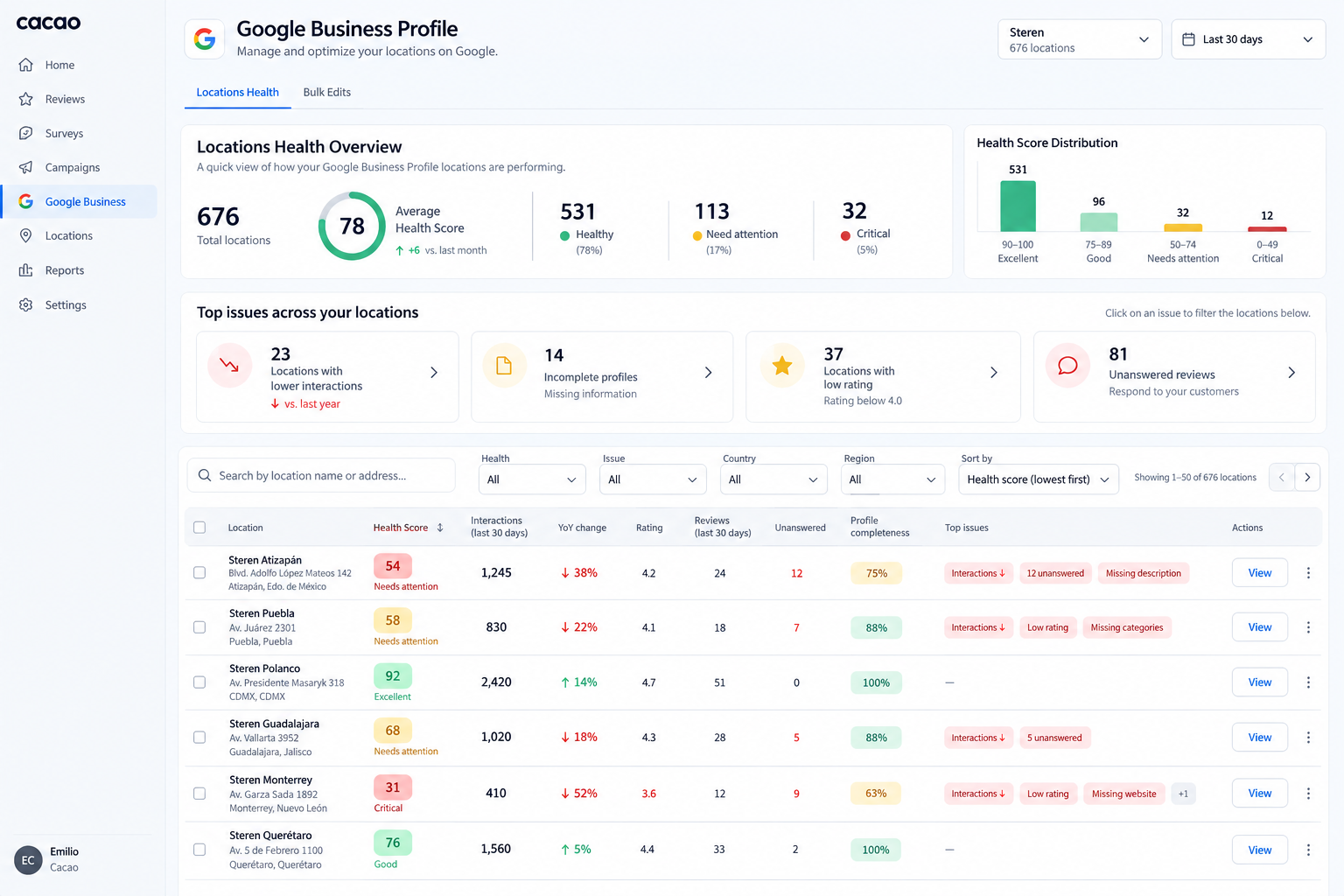
Cacao dashboard used to review profile health across a location network

Start with the purpose and scope of the audit

A multi-location local SEO audit should answer three questions: which locations have material problems, what evidence explains each problem, and which fixes deserve attention first. It is not a checklist that gives every branch the same score without market context.

This audit is a supporting process within the broader multi-location SEO operating framework. Define the countries, brands, location statuses, reporting period, priority searches, and responsible teams before collecting data.

Build a verified inventory of every location

Create one row per real location and reconcile the website, internal store list, Google Business Profiles, and operational systems. Record location ID, brand, region, address, status, profile URL, website URL, ownership, and responsible team.

Separate active, temporarily closed, permanently closed, opening soon, relocated, and duplicate entities. An incomplete inventory makes every later comparison unreliable.

  • Match every active location to the correct Google Business Profile.
  • Flag profiles with unknown ownership or access.
  • Document duplicates, moves, closures, and missing locations.
  • Use a stable internal location ID across exports and systems.

Assign an owner to every audit layer

Audit layer

  • Profile inventory, access, duplicates, and standards
  • Review, ranking, and interaction reporting
  • Cross-location comparison and prioritization
  • Escalation rules and remediation tracking

Typical owner

  • Corporate or local operations
  • Reputation or marketing team
  • SEO, web, or analytics team
  • Named owner with a due date

Audit Google Business Profile status and completeness

Check verification and access first, then review business name, categories, address or service area, phone, regular and special hours, website URL, services, attributes, and photos against real-world information.

Centralized Google Business Profile management can make gaps, duplicates, suspensions, and inconsistent fields easier to find across a large network.

Treat completeness as a controllable quality standard, not proof that a location will rank. Fix factual problems before drawing conclusions from visibility data.

Find duplicates, suspensions, and access risks

A duplicate can divide customer activity or confuse the team about which profile is authoritative. A suspension or lost-owner account can stop normal operations entirely. These are usually higher priority than incremental optimization work.

Record the affected profile, evidence, current owner, escalation route, and remediation status. Do not merge, remove, or recreate profiles without confirming the real entity and applicable Google guidance.

Audit review velocity and rating distribution

Measure review volume, recent review pace, average rating, rating distribution, and change over time by location. Compare branches with similar formats and markets instead of relying only on one network average.

If locations with real customer traffic receive few recent reviews, inspect the location-level review collection workflow and whether customers reach the correct profile.

The audit should reveal operational gaps; it should not prescribe review text, gate customers, or incentivize only positive feedback.

Audit unanswered reviews and recurring themes

Count unanswered reviews by age, rating, location, and region. Check whether sensitive or low-rating feedback reaches the right owner and whether responses are specific, timely, and consistent with brand guidance.

Use multi-location review analytics to look beyond response rate and find recurring themes that may explain weak customer choice or declining interactions.

Repeated service, wait-time, product, access, or staff complaints are operational evidence. They should not be reduced to an SEO task.

Audit every website location page

Confirm that each active location has one useful, indexable page and that the profile links to the correct destination. Check status code, canonical, indexation, internal links, visible name, address, phone, hours, services, directions, and appropriate structured data.

Flag missing pages, homepage links used in place of location URLs, thin city-swapped copy, inconsistent business information, orphan pages, and closed-location pages without a deliberate redirect or retirement plan.

Cacao does not create or manage location pages, schema, indexation, or technical SEO. Assign these findings to the web or SEO team while keeping them in the shared audit queue.

Audit local rankings with consistent geo-grids

Choose a small set of priority queries for each location type and use a consistent grid configuration for comparable markets. Record the date, search term, radius, grid size, and relevant competitors.

Use the multi-location ranking diagnosis guide when a branch has weak or unusual coverage. A geo-grid is evidence for diagnosis—not a standalone explanation of why the result occurred.

Avoid one universal rank target. Proximity, market density, query intent, demand, and competition change what a realistic coverage pattern looks like.

Audit Google interactions and trend changes

Review available calls, website clicks, direction requests, and other profile interactions by location and over time. Note sharp declines, unusual gaps, tracking changes, openings, closures, seasonality, and market differences before comparing branches.

A centralized Google reviews dashboard can help teams connect interaction trends with review and profile context.

Strong visibility with declining interactions is a signal to inspect demand, profile presentation, offer, sentiment, or the downstream journey rather than assuming ranking is the primary problem.

Compare locations without hiding local context

Segment the network by useful characteristics such as brand, format, country, region, maturity, market density, or service model. Compare like with like and retain both current values and trend direction.

Use network summaries to find outliers, then open the underlying location evidence. An average can identify where to look, but it cannot explain why one branch is weak.

  • Separate new locations from established ones.
  • Account for temporary closures and seasonal demand.
  • Compare review pace within relevant peer groups.
  • Review ranking coverage within the actual local market.
Cacao Profile Health Score used to triage locations during a local SEO audit

Use Profile Health Score to triage the network

Cacao uses Profile Health Score to help multi-location teams identify which locations may need attention first. The internal score can combine profile completeness, review performance and velocity, Google interactions, and performance evolution.

Profile Health Score is not a Google ranking factor, and Google does not use Cacao’s score. Treat it as a prioritization layer that points the team toward underlying evidence—not as the diagnosis itself.

Prioritize the highest-impact problems

Score each finding by severity, customer impact, business importance, confidence in the evidence, effort, and whether another task blocks the fix. Critical profile status and accuracy issues generally precede speculative optimization work.

Every action should name the location, finding, evidence, owner, due date, and success measure. Group a shared systemic fix when many locations have the same verified cause, but preserve location-specific work where markets differ.

Turn audit findings into an action queue

FindingBusiness riskRecommended order
Closed, duplicate, suspended, or inaccessible profileCustomers cannot reliably find or trust the locationCritical: resolve first
Incorrect hours, address, phone, or destination URLImmediate customer and conversion impactHigh: correct promptly
Weak visibility plus a verified profile or page gapDiscoverability is constrained by a specific issueHigh: assign the verified fix
Healthy visibility with weaker interactionsRanking may not be the constraintInvestigate journey and offer

Fix, document, and measure again

Resolve the highest-priority issue, record what changed and when, then repeat the relevant measurement using the same setup. Confirm that the factual problem is fixed before attributing any visibility or interaction movement to the work.

Keep critical monitoring continuous and schedule recurring network reviews. The audit is complete only when findings have owners and follow-up—not when a spreadsheet has been filled.

  • Verify the fix in the live profile or page.
  • Repeat the same ranking or interaction comparison.
  • Record unexpected results and revise the hypothesis.
  • Move unresolved findings into the next accountable review.

Find the locations that need attention first

Cacao centralizes profile health, reviews, local visibility, and Google interactions so multi-location teams can move from audit findings to an accountable action queue.

Request a demo

Multi-location local SEO audit FAQ

What is a multi-location local SEO audit?

It is a structured review of every location’s Google Business Profile, reviews, website page, local visibility, and Google interactions. The goal is to find material gaps, compare locations fairly, and prioritize fixes across the network.

How often should a multi-location business run an audit?

Monitor critical profile and review issues continuously, use a recurring network review for trend changes, and run deeper audits when locations open, close, migrate systems, lose visibility, or show unexplained performance differences.

Should every location use the same audit benchmark?

No. Shared standards are useful for accuracy and completeness, but rankings, review velocity, demand, and interactions must be interpreted in local market context. Compare like with like where possible.

Is Cacao Profile Health Score a Google ranking factor?

No. Profile Health Score is Cacao’s internal prioritization metric. It helps teams surface locations that may need attention; Google does not use the score as a ranking factor.

What should happen after the audit?

Create a location-level action queue with severity, evidence, owner, due date, and success measure. Fix critical accuracy and access problems first, then test the most plausible visibility or conversion constraint and measure again.