
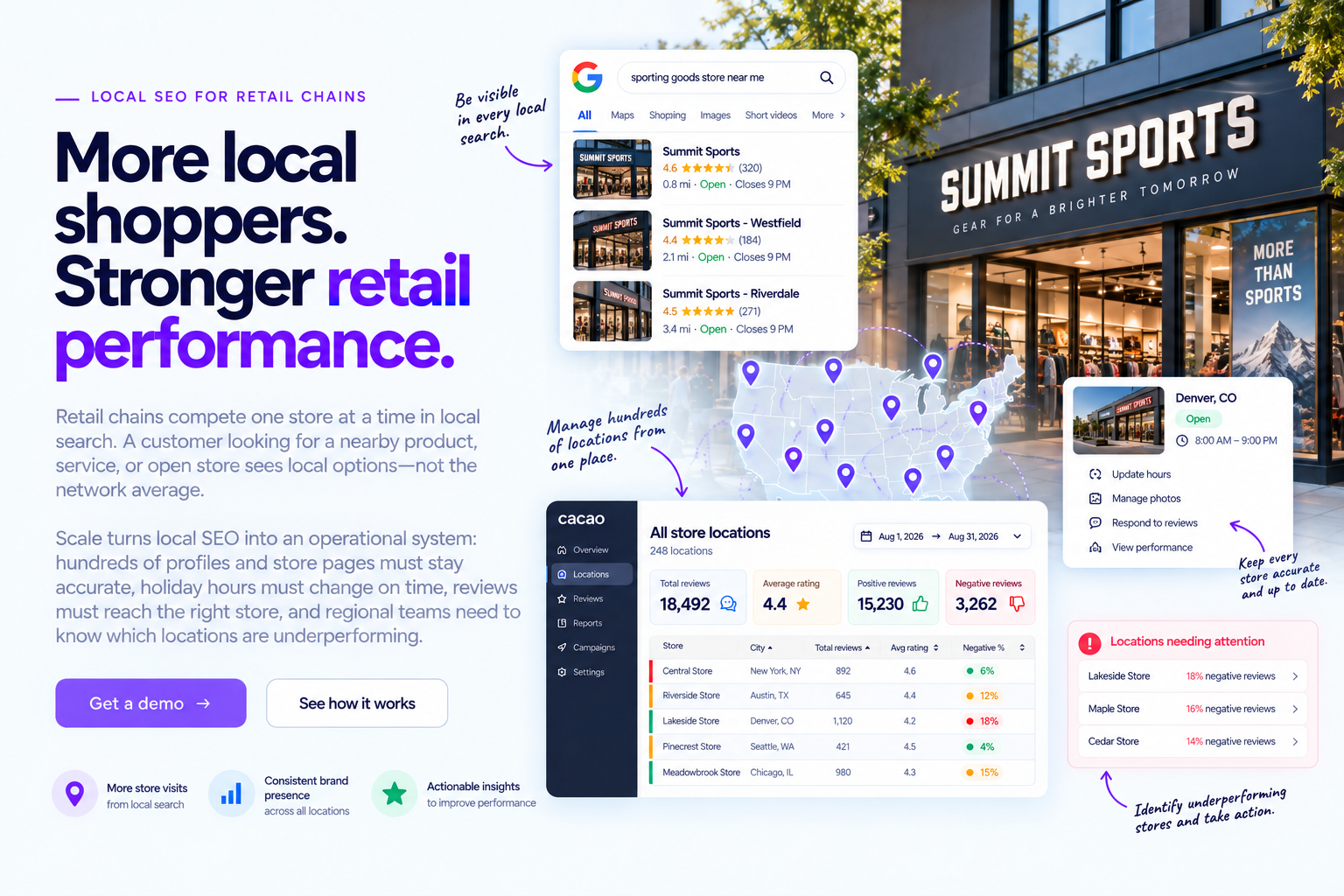

Why retail chains need a store-level system
A strong brand does not guarantee that every store appears for nearby searches. Each location has its own proximity, competitors, profile quality, reviews, store page, hours, customer experience, and demand.
Headquarters needs network standards and visibility, but it cannot verify every local change alone. The system must make store-level accuracy easy, surface exceptions, and assign each action to the team that can complete it.
Define corporate, regional, and store ownership
Corporate should control account ownership, naming rules, categories, required fields, website templates, reporting, permissions, and escalation. Regional teams should review performance and coordinate exceptions. Store teams should verify real-world facts, flag operational changes, provide current photos, and create legitimate review opportunities.
| Corporate | Regional | Store |
|---|---|---|
| Profile governance and brand standards | Market-level quality control | Hours and local fact verification |
| Store-page templates and analytics | Underperforming-store follow-up | Current photos and local context |
| Reporting and escalation rules | Regional review and visibility trends | Customer experience follow-through |
| Technology and access permissions | Support for local exceptions | Compliant review opportunities |
Create one source of truth for every store
Maintain a verified inventory with store ID, brand, status, address, phone, regular and special hours, categories, services, profile URL, store-page URL, region, and owner. Use the same stable store ID across exports and reporting.
A recurring multi-location local SEO audit should reconcile active stores, opening-soon locations, temporary closures, relocations, duplicates, suspended profiles, and permanently closed stores.
Standardize every store Google Business Profile
Verify that every eligible store has the correct profile and that names, addresses, phones, categories, website links, services, attributes, and photos represent the real business.
Centralized Google Business Profile management helps retail teams coordinate individual and bulk changes while preserving store-specific information.
- Use the real business name without keyword additions.
- Select categories that match what the store actually offers.
- Send the profile to the correct store page.
- Monitor duplicates, ownership problems, and suspensions.
Treat opening hours as customer-critical data
Retail hours change frequently around holidays, seasonal periods, events, weather, renovations, and local regulations. Incorrect hours create wasted trips, poor reviews, and lost trust.
Create a calendar and approval workflow for special hours. Define who submits a change, who verifies it, which systems receive it, and how the team confirms that Google and the store page show the correct information.
Use categories, services, products, and photos accurately
Retail stores may differ by format, department, inventory, service desk, pickup options, accessibility, or in-store experience. Profiles and pages should reflect meaningful differences without making unsupported availability claims.
Use current photos from the real store, including entrances and wayfinding where useful. Product or service information should match what customers can reasonably expect at that location and remain maintainable at scale.
Build a useful page and finder for every store
Each active store should have one indexable page with accurate NAP data, hours, services or products, directions, accessibility, parking, pickup or booking options, and other information customers need before visiting.
Use the complete guide to location pages for multi-location businesses to plan URLs, local content, schema, internal links, indexation, and store lifecycle changes.
The store finder must expose crawlable links rather than relying only on an interactive map or internal search. Cacao does not build store pages, implement schema, or manage technical SEO.
Generate reviews for the correct store
Network totals can hide stores with little recent customer feedback. Build review requests into genuine post-purchase or service moments and route customers to the location they actually visited.
Cacao’s review collection workflows help headquarters monitor location-level participation without directing the entire network to one profile.
- Track review volume and velocity by store.
- Compare stores within relevant formats and markets.
- Do not gate feedback or script positive review content.
- Use recurring themes to identify operational problems.
Respond consistently without erasing local context
Corporate should define tone, response standards, sensitive topics, escalation paths, and turnaround expectations. Responses should still acknowledge the specific experience rather than repeating one template across hundreds of stores.
AI-assisted review responses can help retail teams manage volume while retaining oversight, store context, and brand controls.
Measure local visibility by store and market
Track a focused set of priority queries for each store format. Geo-grid reporting can show how visibility changes around a location and where nearby competitors appear.
When a store is weak, follow a structured multi-location ranking diagnosis instead of applying the same optimization checklist to the whole chain.
Interpret rankings in context: proximity, query intent, density, competition, store maturity, and demand all influence the pattern.
Connect visibility to Google interactions and store outcomes
Measure available calls, website clicks, direction requests, and other profile interactions by store and over time. Connect those signals with store-page traffic, pickup or appointment actions, and internal store outcomes where reliable data exists.
Strong rankings with declining interactions may indicate that discoverability is not the main constraint. Inspect demand, hours, offer, profile presentation, reviews, and downstream journey before prescribing more ranking work.
Compare regions and find underperforming stores
Segment stores by brand, format, maturity, market density, region, and other meaningful characteristics. Use summaries to find outliers, then open the underlying profile, review, visibility, interaction, and page evidence.
Cacao’s Profile Health Score can help teams prioritize stores using profile completeness, review performance and velocity, Google interactions, and performance evolution. It is an internal Cacao metric—not a Google ranking factor.
Proof that multi-location analysis can operate at scale
Cacao has analyzed 94,393+ Google reviews across 676 locations for a single multi-location organization. This verified example demonstrates the ability to organize large review datasets into location-level and group-level analysis.
It does not identify the organization as a retail customer or claim ranking, revenue, or conversion improvements. The evidence supports platform scale, not an invented retail case study.
Explore the underlying multi-location review analytics workflow for quantitative and qualitative comparisons across large networks.
Run retail local SEO as a continuous operating loop
Control store data, measure each market, prioritize verified gaps, assign the owner, fix the highest-impact issue, generate and respond to reviews, track visibility, and measure interactions again.
Cacao supports the Google and review operations in that loop: centralized profile management, review generation, review monitoring and analysis, AI-assisted responses, geo-grid visibility, Profile Health Score, and multi-location reporting.
Website development, store-page content, schema, citations, link building, merchandising, and in-store operations remain with the teams and systems that own those responsibilities.
Retail chain local SEO FAQ
What is local SEO for retail chains?
It is the coordinated process of improving local search visibility and customer journeys for every store through accurate Google Business Profiles, useful store pages, reviews, local visibility tracking, and clear corporate, regional, and store-level ownership.
Does every retail store need its own Google Business Profile?
Each eligible physical store should generally have its own accurate profile so customers can find its location, hours, phone number, products or services, and reviews. Profiles must follow Google’s eligibility and representation guidelines.
Should every store have a website page?
In most cases, yes. Each active store should have a useful, indexable page with accurate business information, directions, relevant products or services, and conversion actions. The page should be linked from a crawlable store finder.
What should retail chains measure?
Measure profile accuracy, review volume and velocity, rating trends, unanswered reviews, geo-grid visibility, Google interactions, store-page traffic, conversion actions, and differences between comparable stores and regions.
How should corporate and store teams divide local SEO work?
Corporate should own profile access, standards, technology, templates, reporting, and escalation. Regional and store teams should verify local facts, provide current context and photos, create compliant review opportunities, and act on operational issues.
Make every store visible and accountable
Cacao helps retail chains manage Google Business Profiles, reviews, responses, local visibility, and interactions across the network.
Request a demo