

Why brand consistency gets harder as location count grows
Growth distributes ownership. Business information may sit with operations, review responses with local managers, customer-feedback programs with marketing, and exceptions with regional leaders. Without a shared operating model, each team can make a reasonable decision that still produces an inconsistent network.
The most visible problems are often operational: outdated hours, incomplete profiles, uneven response coverage, conflicting tones, unclear escalation, and reports that hide weak locations inside a company-wide average.
- More people can change customer-facing information.
- Local markets require legitimate exceptions to corporate defaults.
- Response quality and speed vary when ownership is unclear.
- Corporate teams lose visibility as work spreads across inboxes and accounts.
- Network averages make it difficult to identify execution gaps.
Define what must be consistent—and what can stay local
Consistency starts by separating non-negotiable standards from decisions that benefit from local knowledge. If everything is mandatory, teams cannot respond to real operating conditions. If everything is optional, the brand has no reliable customer experience.
Non-negotiable brand standards
Corporate should define the rules that protect accuracy, customer safety, brand voice, accountability, and comparable measurement.
- Core business-information and profile-completeness standards.
- Response tone, prohibited language, approval, and escalation rules.
- Minimum customer-feedback and review-request standards.
- Ownership, permissions, and reporting definitions.
Locally adaptable decisions
Regional and local teams should be able to reflect facts that genuinely differ by market or location without changing the underlying brand standard.
- Regular and special hours, services, menus, and local attributes.
- Specific context in customer responses and recovery actions.
- Local photos, operational details, and appropriate promotions.
- Escalation context that only the location can verify.
Create a corporate, regional, and local governance model
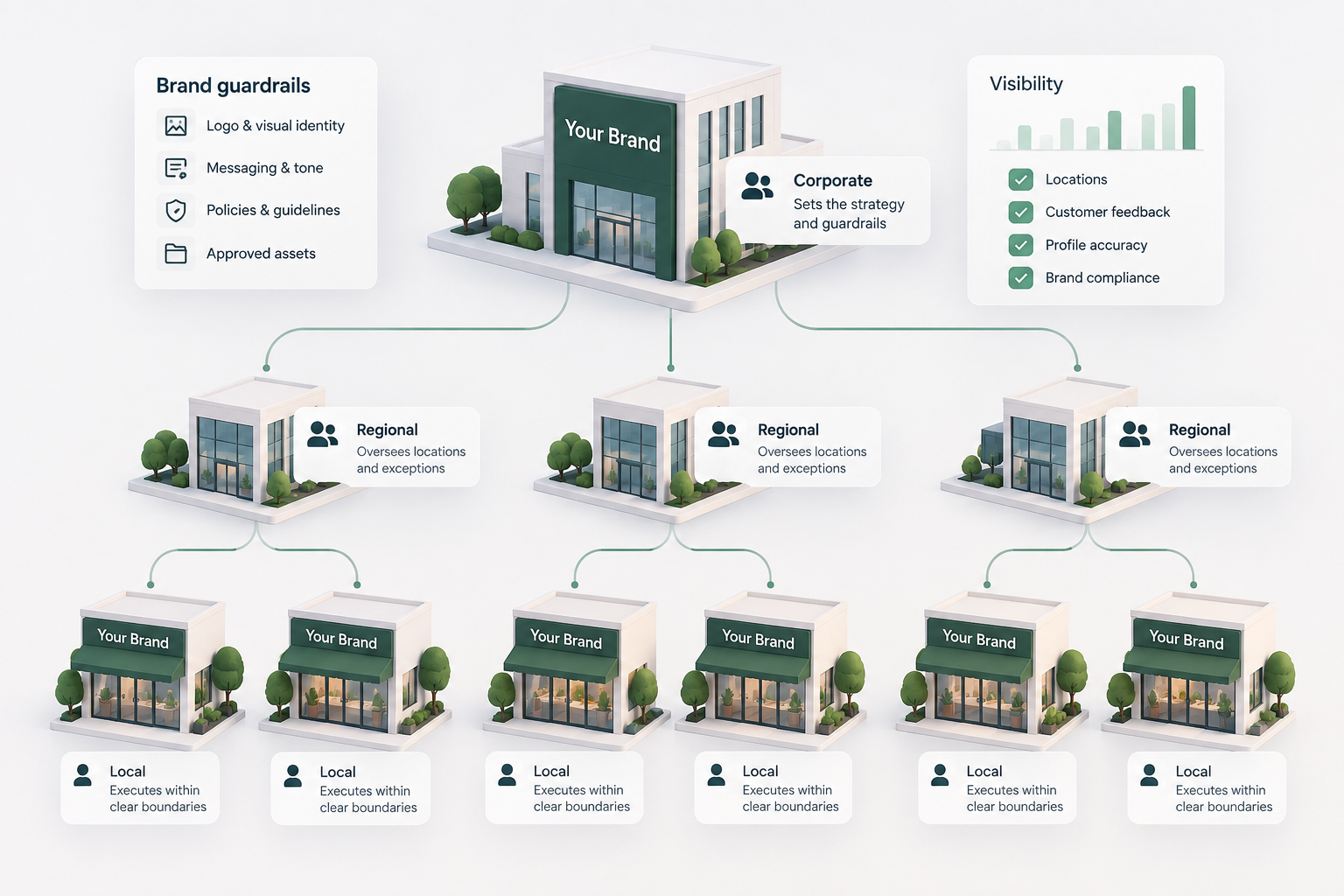
The operating model should follow responsibility. Corporate needs complete visibility without becoming the bottleneck for every action. Regional managers need oversight across assigned markets. Local teams need enough access to keep information accurate and address customer situations quickly.
Role-based location access supports this model by limiting each user to the brands, groups, or locations they are responsible for.
Corporate
Defines standards, access rules, workflow policies, reporting definitions, and exception thresholds. It monitors the network and improves the system when patterns repeat.
Regional teams
Compare assigned locations, coach local teams, review exceptions, and coordinate issues that cross location boundaries.
Local teams
Maintain accurate local facts, add customer context, handle assigned work, and escalate situations that exceed their authority.
Keep Google Business Profiles consistent across locations
Google Business Profiles are where many customers encounter a local branch. Names, categories, phone numbers, websites, regular hours, special hours, descriptions, attributes, services, photos, and posts need shared standards—but they also need to remain factually correct for each location.
Corporate teams can define required fields and common values, use bulk changes for selected locations, and preserve exceptions where local facts differ. They also need visibility into incomplete, duplicate, suspended, or otherwise problematic profiles. Detection does not mean every Google issue can be resolved automatically; some cases still require investigation or Google intervention.
Cacao’s Google Business Profile management software centralizes profile health, editing, bulk operations, permissions, and location-level performance.
Standardize brand voice without making every review response identical
A consistent voice is a set of decisions about tone, greeting, sign-off, sensitive topics, contact instructions, and escalation. It is not a library of identical replies. Copying the same response across locations removes the customer and local context that makes a reply credible.
Organizations can configure shared AI instructions and business context, then choose automatic, hybrid, or approval-based workflows according to risk. Routine cases can move quickly while negative, sensitive, or exceptional reviews reach the appropriate person.
See how AI-assisted review responses preserve guardrails while using the review and location context. For the full ownership workflow, use the guide to centralized review management.
Standardize how locations collect customer feedback
If every branch asks different questions through unrelated channels, corporate cannot compare the experience across the network. Standardize the core survey, attribution, consent, and measurement rules while allowing appropriate differences by market or customer journey.
Shared customer surveys and review collection workflows can use QR codes, links, POS triggers, messaging, and location routing without losing the location that produced the feedback.
- Keep a common set of network-level questions and metrics.
- Attribute each response or request to the correct location.
- Allow local additions only when they serve a defined operational need.
- Separate private feedback from public Google reviews in reporting.
Measure consistency instead of assuming it
Standards do not prove execution. Corporate teams need to compare locations, groups, regions, and the organization over time. The goal is not to punish every difference; it is to distinguish justified local variation from a gap that affects customers or weakens the operating model.
Multi-location review analytics can surface differences in ratings, response activity, sentiment, recurring topics, and historical performance. Profile metrics add adjacent visibility into completeness and Google interactions.
- Which locations repeatedly miss profile or response standards?
- Where are sentiment or recurring topics moving differently from the network?
- Which groups need coaching, resources, or a different local exception?
- Are performance changes isolated, regional, or organization-wide?
Centralized control does not mean centralized execution
Forcing corporate to perform every local action creates a queue that grows with the network. Giving every location unrestricted control creates inconsistent information, weak accountability, and limited oversight. The scalable model sits between those extremes.
Centralize standards. Distribute execution. Centralize visibility. Corporate defines the system, regional teams manage groups and exceptions, local teams act where context matters, and shared reporting closes the loop.
A practical brand consistency framework
Treat the framework as an operating cycle, not a one-time policy document. Standards should improve when local exceptions reveal a better practice or when customer data shows that the current process is not working.
- 1. Define the standards that cannot vary across the network.
- 2. Document the information and decisions that can adapt locally.
- 3. Assign ownership at corporate, regional, and location level.
- 4. Standardize recurring profile, review, response, and feedback workflows.
- 5. Give each person access only to the locations and actions they own.
- 6. Measure performance at location, group, and organization level.
- 7. Review exceptions and recurring gaps on a regular cadence.
Using technology to manage brand consistency at scale
Technology becomes useful when it reinforces the governance model. Look for centralized visibility, grouping, role-based access, bulk profile operations, repeatable review workflows, local execution, exception handling, and reporting that rolls from a location to a region and the full organization.
The right tool depends on the channels the organization needs to govern. Cacao is focused on Google Business Profiles, reviews, customer feedback, and the associated local workflows; it is not a digital asset manager or a complete system for logos, fonts, creative approvals, paid media, or every social channel. Teams evaluating the broader software category can compare multi-location marketing platforms separately.
For the broader local visibility operating system—including websites and ranking work outside Cacao—read the multi-location Local SEO guide.
Frequently asked questions
How do you keep branding consistent across multiple locations?
Define non-negotiable standards, document local flexibility, assign corporate, regional, and local ownership, standardize recurring workflows, restrict access by responsibility, and compare execution across locations.
Should corporate control every local marketing action?
No. Corporate should control the standards and retain visibility, while regional and local teams execute the actions that require market or customer context within defined permissions.
Does brand consistency mean every review response should be the same?
No. Consistency means using the same voice, safeguards, and escalation rules. Each response should still reflect the customer’s review and the location context.
Is Cacao a complete brand management platform?
No. Cacao focuses on Google Business Profiles, Google reviews, review responses, customer feedback, permissions, and location-level reporting. Visual identity systems, digital asset management, paid media, and broader creative governance require other tools.
Coordinate local presence without losing local context
See how Cacao helps corporate, regional, and local teams manage Google profiles, reviews, feedback, and reporting across a multi-location network.
Request a demo