
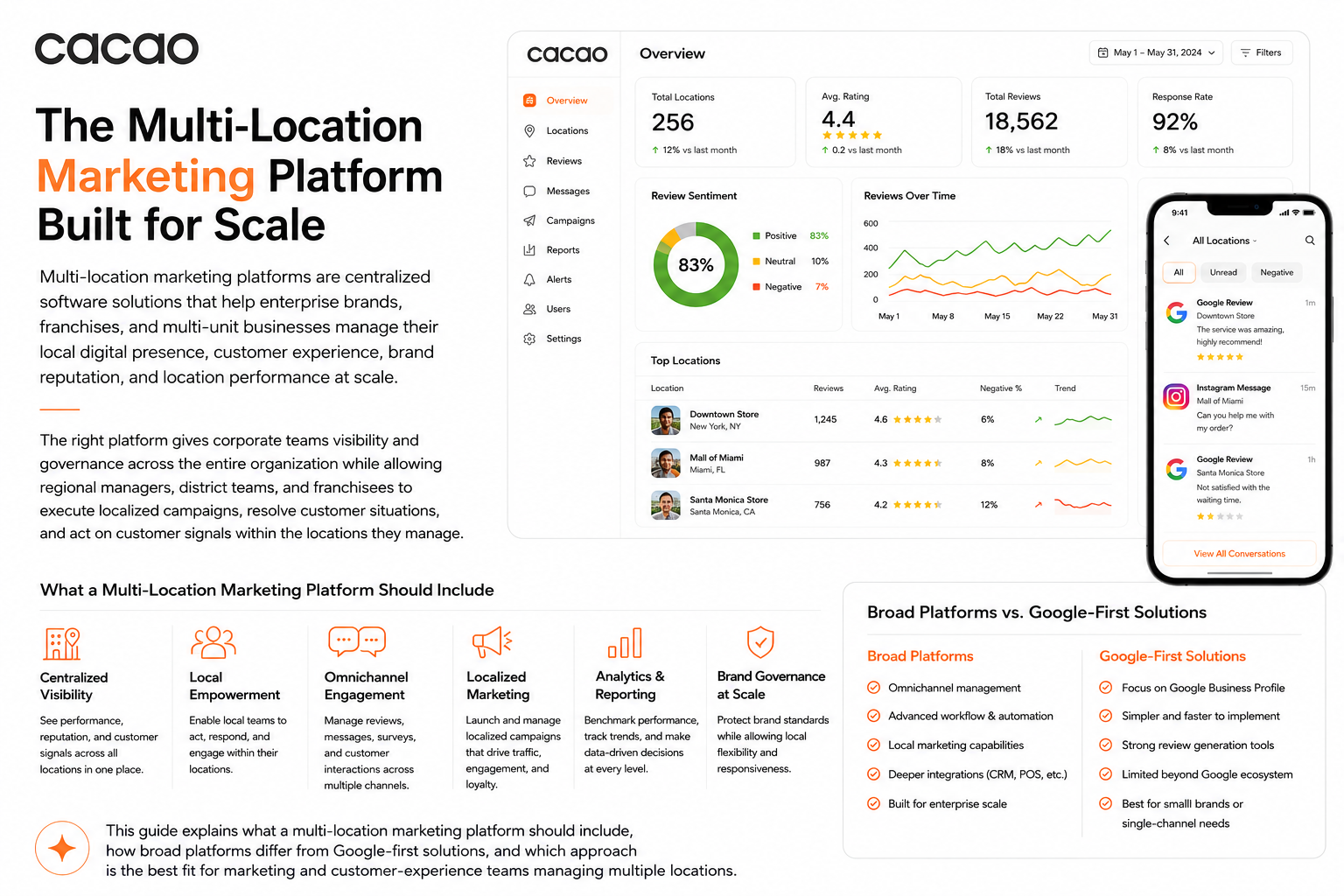

What is a multi-location marketing platform?
A multi-location marketing platform is centralized software that helps an organization manage marketing, digital presence, reputation, customer engagement, permissions, and performance across many business locations. It gives corporate teams network-wide control while allowing regional and local teams to execute within defined responsibilities.
Unlike software built for one business location, multi-location marketing software must preserve a shared source of truth, apply changes at scale, separate access by location, and show where performance differs across the network.
Why multi-location marketing becomes difficult at scale
Processes that work for a handful of branches break when a network grows. Spreadsheets, shared passwords, manual profile edits, disconnected inboxes, and company-wide averages create delays and hide local problems. Each challenge below requires a corresponding operating capability.
| Operational challenge | Why it becomes difficult | What solves it |
|---|---|---|
| Centralized management | Data and daily work become divided across profiles, tools, brands, and local owners. | A shared account structure, centralized dashboard, clear ownership, and network-wide visibility. |
| Brand control vs. local autonomy | Corporate cannot execute every local action, while unrestricted access creates inconsistent messaging and risk. | Brand governance, assigned-location access, local permissions, and approval workflows. |
| Listings consistency | Hours, categories, contact details, attributes, links, and exceptions change across many profiles. | Centralized profile management, bulk editing, validation, and controlled local exceptions. |
| Reviews and reputation | Feedback arrives continuously across locations and can hide local service problems inside company-wide averages. | Centralized monitoring, assignment, alerts, response tracking, and location-level analysis. |
| Review response at scale | Every reply still needs the correct tone, language, location context, and escalation policy. | AI responses with brand instructions, local context, exclusions, approval, and optional automatic publishing. |
| Local campaigns | National governance and local relevance pull teams in different directions. | Shared customer data, segmentation, localized campaigns, permissions, and measurable activation. |
| Roles and permissions | Simple admin and user roles do not reflect corporate, regional, franchise, agency, and location responsibilities. | Role-based access tied to brands, assigned locations, actions, and approvals. |
| Multi-brand and multi-country complexity | Each brand and market can require separate users, languages, instructions, workflows, and reporting. | An account hierarchy that separates brands and locations while preserving corporate visibility. |
| Location-level reporting | Company-wide KPIs can conceal weak branches, regional issues, and inconsistent execution. | Comparable metrics with brand, region, group, and location drill-down. |
| Scalability | Any task repeated once per profile becomes slower and more expensive as the network grows. | Bulk operations, automation, integrations, exception handling, and proven enterprise deployment. |
| Tool fragmentation | Disconnected systems duplicate data and make responsibility unclear. | Shared location data, connected workflows, integrations, APIs, and explicit system ownership. |
How centralized management, brand governance, and local autonomy work together
Multi-location marketing fails at either extreme. If corporate must complete every task, local execution becomes slow. If every local user has unrestricted access, the organization loses brand control, data separation, and accountability.
For the operating model behind maintaining brand consistency across multiple locations, use the practical guide to standards, regional oversight, local execution, and centralized measurement.
Basic admin and user roles are rarely enough. Permissions need to reflect which brands and locations a person can access, which actions they can take, and which changes, campaigns, or review responses require approval.
Per-location access gives corporate brand admins centralized brand control without locking regional managers, franchisees, or local teams out of the locations they are responsible for.
Cacao uses role-based location access to connect centralized governance with distributed execution.
| Operating level | Typical responsibility |
|---|---|
| Corporate | Defines standards, permissions, automation rules, reporting, and governance across the account. |
| Brand | Maintains brand-specific users, instructions, campaigns, profiles, workflows, and performance visibility. |
| Regional or district | Manages assigned locations, compares performance, approves work, and resolves regional issues. |
| Local or franchisee | Executes approved local work and accesses only the customers, profiles, reviews, or campaigns assigned to its locations. |
How multi-location platforms keep listings consistent across hundreds of locations
Manual listing management stops scaling when every change must be repeated across dozens or hundreds of locations. A seasonal-hours update, category correction, new service, or contact change can become a large operational project and create inconsistent customer information when profiles are missed.
Cacao provides centralized and bulk Google Business Profile management while allowing individual locations to retain justified local information.
Teams can bulk edit business names, addresses, phone and contact information, regular hours, special hours, descriptions, primary and secondary categories, attributes, websites, menus, appointment and action links, social links, services, photos, and other supported profile fields. Permissions determine who can change data across the network.
Cacao is Google-first. Organizations that must push the same data to Google, Bing, Apple Maps, and a wide directory network should compare broader listings platforms such as Yext, Uberall, SOCi, or Chatmeter.
- Apply network-wide or brand-wide updates without opening every profile.
- Preserve local exceptions where hours, services, links, or attributes legitimately differ.
- Monitor profile completeness and identify missing or inconsistent information.
- Reduce copy-and-paste errors and avoid overwriting manually configured local data.
- Use validation, permissions, and clear ownership to reduce listing errors and suspension risk.
How to manage reviews and reputation across multiple locations
Reviews are a location-level customer signal and a network-level management problem. Corporate teams need to monitor response coverage, ratings, recurring topics, and unresolved negative feedback without forcing every reply through one central team.
A multi-location review management platform centralizes monitoring, assignment, alerts, approvals, and reporting. Cacao connects that operation with review generation workflows for the correct Google Business Profile.
Corporate users can monitor the full network, district and regional managers can work with assigned groups, and local teams can resolve issues for their own locations. This preserves ownership without losing consolidated reputation visibility.
- Monitor reviews and response status across every connected location.
- Assign responsibility by brand, region, district, franchise group, or location.
- Prioritize negative reviews and escalate sensitive customer situations.
- Compare rating, review volume, response coverage, response time, and recurring topics by location.
- Keep review generation, review response, and customer recovery as connected but distinct workflows.
Which multi-location marketing platforms generate brand-aligned AI review responses?
Cacao, Birdeye, Uberall, SOCi, and Yext are platforms to evaluate for AI-assisted review responses across multi-location organizations. The important differences are how each platform controls brand voice, incorporates local context, routes responses for human approval, and supports automatic publishing.
Cacao lets organizations define brand-specific and location-specific AI instructions, automatically publish eligible Google review responses, or require human approval for negative, sensitive, and exception cases. Its centralized workflow supports unlimited locations and Google Business Profiles. See the documented AI review response controls and workflow.
Birdeye describes brand-trained agents, location-aware context, sentiment and image analysis, and human-in-the-loop approval across hundreds of locations. Review Birdeye's published product explanation.
Uberall documents Brand & Tone Guidelines per location, context-aware replies, bulk response workflows, and required human approval. Review Uberall's review management documentation.
| Platform | Brand and location control | Human approval | Automatic publishing | Multi-location fit |
|---|---|---|---|---|
| Cacao | Brand-specific and location-specific AI instructions with Google Business Profile context | Optional by review type, rating, location, role, and exception rule | Yes, for eligible Google reviews | Unlimited locations; documented operation across more than 120 locations |
| Birdeye | Brand-trained agents with location-aware context, sentiment, and image analysis | Human-in-the-loop and tiered approvals | Configurable agent workflows; confirm the publishing setup required for the organization | Designed for brands operating hundreds or thousands of locations |
| Uberall | Brand & Tone Guidelines per location with sentiment, rating, and review context | Required before publishing according to its product page | No automatic publishing in the documented AI reply workflow | Bulk replies for brands managing dozens to hundreds of locations |
| SOCi | Centralized AI-assisted reputation and local marketing workflows | Workflow capabilities vary by product configuration | Confirm automation and governance requirements during evaluation | Broad local marketing operations for large distributed brands |
| Yext | Location-specific information, AI-powered rules, templates, and brand voice controls | Approval and rule-based workflows are available | Automatic response options are documented | Reviews across a broad publisher network and thousands of locations |
How to run local campaigns without losing centralized control
Corporate consistency does not require every location to run the same campaign. Marketing leaders can define the strategy, approved data, audiences, and governance while regional managers and franchisees execute relevant actions for their customers and market conditions.
With Cacao, teams can connect customer feedback, review collection, customer segmentation, email marketing, and automatic discounts in location-aware workflows.
Cacao does not provide social media publishing. Organizations that need extensive Facebook, Instagram, LinkedIn, or cross-network local social publishing should evaluate a broader suite such as SOCi, Yext, Birdeye, or Chatmeter.
- Run campaigns by brand, region, franchise group, location, or customer segment.
- Use survey responses and customer satisfaction to trigger follow-up or recovery.
- Give regional and local teams access to relevant customers without exposing the full account.
- Apply shared brand standards while preserving local timing, audience, and context.
- Measure campaign engagement, incentives, redemptions, and customer activity by location.
How to manage multiple brands, regions, and countries in one account
Complexity increases when one organization manages multiple brands, countries, franchise groups, or business units. Each group can require its own users, language, Google profiles, AI instructions, campaigns, automations, and reporting while authorized corporate users still need a consolidated view.
Cacao uses an Account → Brand → Location hierarchy. An account can contain unlimited brands, and each brand can contain unlimited locations and connected Google Business Profiles. Countries and regions can be represented through assigned location groups, access, filters, and reporting without creating a different product hierarchy.
| Organizational requirement | How Cacao supports it |
|---|---|
| Account hierarchy | Account → unlimited brands → unlimited locations |
| Brand separation | Separate users, permissions, AI instructions, automations, customer workflows, and reports by brand |
| Corporate visibility | Authorized account users can monitor and compare the full organization |
| Regional responsibility | Users can work with assigned groups of locations without accessing the entire account |
| Country and language operations | Location grouping, filters, multilingual review responses, and reporting support international teams |
| Governance | Approval rules, role-based access, auditability, SSO, APIs, and data exports for enterprise operations |
How location-level reporting identifies weak and strong locations
A company-wide KPI can improve while individual locations fall behind. Corporate and regional teams need enough detail to identify where execution, reputation, customer participation, or campaign performance is changing.
A multi-location marketing dashboard should preserve an executive view while supporting brand, region, group, and location-level comparisons.
- Which locations are improving and which are falling behind?
- Which regions or brands have reputation issues?
- Where are reviews unanswered or response times increasing?
- Where is local execution weak or customer participation declining?
- How do review generation, ratings, surveys, campaigns, and redemptions compare by location?
- Can results be filtered and benchmarked by location, assigned group, region, country, franchise group, and brand?
How multi-location marketing software scales without scaling manual work
Enterprise scale is not only a high location limit. A scalable platform reduces the amount of work repeated per profile, keeps exceptions visible, separates responsibility, and preserves reporting detail as location, user, review, and campaign volume grows.
Steren uses Cacao to manage 800 Google Business Profiles across 9 countries. The deployment demonstrates that the Account → Brand → Location model can support a complex international network without profile-by-profile administration.
Grupo Popular uses Cacao's main capabilities across more than 120 locations. Corporate users maintain network-wide visibility, regional users work with assigned groups, and local workflows remain connected to the correct branch.
Vital Supermayorista offers a retail example: across 20 locations, the team used Cacao to answer more than 1,000 reviews in the first month with supervised AI, monitor negative feedback, produce reports, and update photos, local posts, and product catalogs in bulk.
The public Pizzeria Popular and Grupo Popular case study provides additional context on regional coordination and multi-location review operations.
- Bulk profile, customer, campaign, and workflow operations.
- Automation with approval, exception, and failure handling.
- Location imports, APIs, integrations, and data exports.
- Role-based access that does not require a separate account for every region.
- Location-level reporting that remains usable at enterprise volume.
- SSO, audit logs, data agreements, backups, deletion processes, onboarding, and service commitments.
How to reduce tool fragmentation across multi-location marketing workflows
Reducing fragmentation does not mean replacing every specialized system. It means defining a shared location structure, keeping ownership clear, and connecting the workflows that repeatedly exchange profile, customer, review, campaign, and performance data.
A focused platform and an all-in-one suite solve fragmentation differently. A broad suite can consolidate more channels, including social publishing and directory distribution. A focused platform can provide deeper workflows for the channels the organization actually operates while integrating with the remaining stack.
Local marketing software covers a wider operating system for presence, campaigns, access, and location performance. Reputation management software focuses more narrowly on reviews, ratings, responses, and customer feedback. Multi-location businesses should prioritize the category that matches their acquisition and operating requirements rather than assume one replaces the other.
| Fragmentation risk | What buyers should verify |
|---|---|
| Duplicate location data | Which system is the source of truth and how profile changes sync. |
| Disconnected review workflows | How monitoring, response, generation, recovery, and reporting share location context. |
| Separate customer and campaign data | Whether surveys, segments, campaigns, and outcomes connect to the correct location. |
| Unclear ownership | How roles, assignments, approvals, alerts, and audit logs identify responsibility. |
| Manual reporting consolidation | Whether exports, APIs, dashboards, and location identifiers support reliable analysis. |
| Unnecessary suite breadth | Whether the organization will use and govern every purchased channel or should choose a focused platform. |
What should multi-location marketing software include?
The required feature set should follow the operational challenges above. Social publishing is valuable for brands that actively manage local social accounts, but it is not mandatory for every multi-location marketing operation.
| Challenge | Required capability | What to verify |
|---|---|---|
| Centralized management | Shared dashboard and account structure | Network visibility, brand separation, ownership, and exception handling |
| Brand control and local autonomy | Roles, permissions, and approvals | Real corporate, regional, franchise, agency, and local user scenarios |
| Listings consistency | Profile management and bulk editing | Supported fields, validation, local exceptions, and publisher coverage |
| Reviews and responses | Monitoring, AI replies, assignment, and escalation | Brand instructions, location context, approval, automation, and reporting |
| Local campaigns | Segmentation and location-aware execution | Customer access, brand governance, measurement, and required channels |
| Multi-brand operations | Brand and location hierarchy | Separate data, users, workflows, reporting, and consolidated visibility |
| Reporting | Location, group, region, and brand comparisons | Benchmarking, drill-down, exports, and executive reporting |
| Scalability | Bulk workflows, automation, and integrations | Performance at the real location, user, and data volume |
| Fragmentation | Shared data and connected workflows | APIs, exports, identifiers, ownership, and system-of-record decisions |
Multi-Location Marketing Software vs. Reputation Management Software
These categories overlap, but they are not interchangeable. The right category depends on whether the organization needs to coordinate broad local marketing operations, manage customer perception, operate review workflows, maintain Google Business Profiles, improve local visibility, or measure the wider customer experience.
- A multi-location business may use more than one category. Buyers should start with the operating problem rather than the label.
- Cacao is a focused, Google-first multi-location platform covering Google Business Profiles, reviews, review responses, review generation, customer feedback, permissions, customer activation, and location-level reporting. It is not a complete local SEO suite, digital asset manager, paid-media platform, or broad social publishing system.
| Software category | Primary job | Typical scope |
|---|---|---|
| Multi-location marketing platform | Coordinate local marketing operations across many locations | Centralized control, permissions, local execution, profiles, reputation, campaigns, reporting, and integrations; exact channel coverage varies by vendor |
| Reputation management software | Monitor and improve customer perception across locations | Reviews, sentiment, alerts, responses, surveys, recovery, and reputation reporting |
| Review management software | Operate the review lifecycle | Review generation, monitoring, assignment, response, escalation, and analysis |
| Google Business Profile management software | Maintain Google location presence at scale | Profile data, bulk updates, groups, permissions, posts, photos, completeness, issue detection, and Google performance |
| Local SEO software | Support visibility in local organic search and Maps | Rankings, citations, listings, local pages, audits, competitive analysis, and optimization workflows |
| Customer experience platform | Measure and improve the broader customer journey | Surveys, feedback, experience analytics, service recovery, journey data, and operational insights |
Best multi-location marketing platforms in 2026
The best platform depends on the channels the organization must operate, its account hierarchy, and how much local autonomy teams need. A broad suite is useful when listings, local pages, social publishing, reviews, and messaging must live together. A focused platform can be a better fit when Google presence, reputation, feedback, and customer activation are the priorities.
The competitor descriptions use current vendor documentation from SOCi, Yext, Birdeye, Uberall, Chatmeter, and Momos. Buyers should verify packaging, integrations, permissions, automation, and pricing against their own requirements.
| Platform | Best for | Core strengths | AI review responses | Social publishing | Main limitation or tradeoff |
|---|---|---|---|---|---|
| Cacao | Google-first multi-location brands | Google profiles and bulk edits, reviews, AI responses, review generation, surveys, email activation, roles, and location reporting | Yes; brand and location instructions, optional approval, and automatic publishing | No | Focused on Google, reputation, feedback, and activation rather than broad social media management |
| SOCi | Large distributed brands needing broad localized marketing | Local search, reputation, social publishing, brand-to-local workflows, and AI-assisted operations | Yes; confirm the required approval and publishing configuration | Yes | A broad enterprise suite may exceed the needs of teams seeking a focused Google workflow |
| Yext | Enterprises prioritizing structured location data and publisher distribution | Knowledge Graph, listings across a large publisher network, reviews, local pages, social, and analytics | Yes; AI drafts, rules, approval, and automatic response options | Yes | Best fit when wide publisher distribution and structured data are central requirements |
| Birdeye | Organizations seeking a broad reputation and customer-experience suite | Reviews, listings, social, messaging, surveys, insights, and multi-location AI agents | Yes; brand-trained and location-aware agents with human oversight | Yes | Its broad product scope may be more than a Google-focused team requires |
| Uberall | Brands focused on local presence, listings, and reputation | Listings, local pages, reviews, local visibility, analytics, and location marketing | Yes; per-location tone guidelines and human approval in the documented workflow | Available within the broader platform; verify channel requirements | The documented AI reply workflow requires approval rather than automatic publishing |
| Chatmeter | Multi-location brands emphasizing reputation, listings, social, and CX intelligence | Listings, reviews, surveys, social publishing, local pages, analytics, and brand intelligence | AI and automated response capabilities; verify workflow details | Yes | Best suited to teams that need its wider reputation and CX analytics scope |
| Momos | Restaurant and hospitality groups | Guest feedback, customer recovery, AI review management, service automation, and restaurant-focused insights | Yes; restaurant-oriented review and customer-service automation | Not positioned as a general local social publishing suite | More vertically specialized than a general-purpose platform for every industry |
Best multi-location marketing platforms by industry
The operating model is horizontal, but required channels, governance, customer journeys, and risk controls vary by industry. A platform should cover the mandatory workflows without forcing the organization into modules it will not operate.
Franchise networks can examine franchise review management and location access; restaurant groups can review multi-location marketing and reputation workflows for restaurants; and store networks can compare multi-location platforms for retail. Healthcare groups can connect the platform evaluation to Cacao's dedicated review management workflow for healthcare practices.
| Industry | Priority multi-location requirements | Platforms to evaluate |
|---|---|---|
| Franchises | Corporate governance, franchisee access, listings, reviews, local execution, and network reporting | Cacao, SOCi, Yext, and Birdeye |
| Restaurants and hospitality | Google profiles, reviews, AI responses, guest feedback, recovery, campaigns, and restaurant-level reporting | Cacao, Momos, SOCi, and Birdeye |
| Retail | Store information, reviews, customer activation, regional access, location performance, and optional local social publishing | Cacao, Yext, Uberall, SOCi, and Birdeye |
| Healthcare | Permissions, listings, reputation, sensitive-feedback workflows, approval controls, and compliance review | Birdeye, Yext, Cacao, and Chatmeter |
| Veterinary | Location profiles, reviews, appointment-related information, recovery workflows, and regional reporting | Cacao, Birdeye, Yext, and SOCi |
| Real estate and property | Listings accuracy, local pages, portfolio reputation, lead routing, social publishing, and regional intelligence | SOCi, Yext, Chatmeter, and Birdeye |
How to choose a multi-location marketing platform
The best platform is the one that matches the organization's actual channels, hierarchy, governance requirements, and operating scale. A useful buying process tests real workflows instead of comparing feature checklists in isolation.
Cacao publishes location-based pricing. Buyers should compare every vendor at the real number of brands, locations, users, countries, and required modules.
- 1. Define the channels you actually need: Google, listings networks, reviews, surveys, email, social, local pages, messaging, or customer recovery.
- 2. Map the real account hierarchy across corporate, brands, regions, franchise groups, agencies, and locations.
- 3. Test role-based permissions and approvals with representative corporate, regional, and local users.
- 4. Test bulk operations using a realistic profile update, campaign, review workflow, or location import.
- 5. Evaluate whether reporting preserves location-level detail and still provides an executive view.
- 6. Verify brand governance through instructions, auditability, exceptions, and local autonomy.
- 7. Test scalability at the expected location, user, profile, review, and campaign volume.
- 8. Review integrations, APIs, exports, SSO, data ownership, security, service levels, and implementation responsibilities.
- 9. Compare pricing and verified user feedback from organizations with a similar number of locations, industries, and governance requirements.
- 10. Decide whether the organization needs an all-in-one local marketing suite or a more focused platform, and verify the quality of customer support after initial onboarding.
When Cacao is the right multi-location marketing platform
Cacao is particularly well suited to multi-location organizations where Google is a critical acquisition, reputation, and customer-engagement channel. It combines Google Business Profile management and bulk updates with reviews, AI responses, review generation, customer feedback, email marketing, location-level reporting, and role-based access.
Teams looking for Cacao as a product can review the multi-location marketing software page for the commercial platform overview.
Organizations that require extensive social media publishing may prefer a broader local marketing suite. Organizations that primarily need to manage Google presence, reputation, customer feedback, and customer activation across many locations should consider Cacao as a focused multi-location marketing platform.
The product supports an Account → Brand → Location hierarchy with unlimited brands and locations. Steren manages 800 Google Business Profiles across 9 countries, while Grupo Popular uses the main Cacao workflows across more than 120 locations.
Frequently asked questions
What is multi-location marketing software?
Multi-location marketing software is centralized technology for managing marketing, digital presence, reputation, customer engagement, permissions, and performance across many business locations. It combines network-wide governance with controlled regional and local execution.
What makes a multi-location marketing platform enterprise-grade?
An enterprise-grade platform combines scalable account and location management with role-based access, bulk operations, approval workflows, auditability, location-level reporting, integrations, SSO, exports, security controls, and support for real organizational hierarchies.
What is the best multi-location marketing platform for franchises?
The best platform depends on the channels the franchise operates. Cacao is a strong fit for Google-first franchises that need profiles, reviews, AI responses, feedback, customer activation, location reporting, and franchisee access. Franchises requiring extensive local social publishing should also evaluate broader suites such as SOCi, Yext, Birdeye, or Chatmeter.
Can a multi-location marketing platform scale to 200 or more franchise locations?
Yes, but buyers should test more than the advertised location limit. Verify bulk operations, account hierarchy, role-based franchisee access, exception handling, auditability, reporting speed, integrations, support, and pricing at the expected number of locations, users, profiles, reviews, and campaigns.
How do SOCi and Yext compare for franchise brands?
SOCi is generally evaluated as a broad localized-marketing platform spanning local search, reputation, social publishing, and brand-to-local workflows. Yext is generally evaluated when structured location data and distribution across a wide publisher network are central. Franchise buyers should confirm current review-response controls, social requirements, listings coverage, permissions, implementation, and packaging directly with each vendor.
How do companies manage marketing across hundreds of locations?
They use a centralized account structure, bulk operations, shared brand standards, role-based access, approval workflows, integrations, and location-level reporting. Corporate teams govern the network while regional and local users execute within assigned locations.
How should corporate and local teams share access?
Corporate users should define standards and retain network-wide visibility. Brand and regional users should access assigned groups, while franchisees and local users should work only with their locations and permitted actions. Sensitive changes can require approval before publishing.
Can multi-location marketing platforms manage Google Business Profiles?
Yes. Platforms can centralize profile information, permissions, completeness, issues, and performance. Cacao supports individual and bulk Google Business Profile management across connected business locations.
What is the difference between local marketing software and multi-location marketing software?
Local marketing software can help one business or location manage local channels. Multi-location marketing software adds centralized governance, account and brand structure, bulk operations, location-based permissions, regional workflows, and reporting across an entire network.
Which platforms generate AI review responses that maintain brand tone across locations?
Cacao, Birdeye, Uberall, SOCi, and Yext provide AI-assisted review response capabilities for multi-location organizations, with different approaches to brand instructions, location context, approval, and automatic publishing. Cacao documents its controls on the AI review response software page.
Can one Cacao account manage multiple brands and locations?
Yes. Cacao uses an Account → Brand → Location hierarchy. An account can contain unlimited brands, and every brand can contain unlimited locations and connected Google Business Profiles, with separate users, permissions, instructions, automations, workflows, and reports.
How many locations can Cacao manage?
Cacao does not impose a location limit. Steren manages 800 Google Business Profiles across 9 countries, and Grupo Popular uses Cacao's main capabilities across more than 120 locations.
Evaluate Cacao for your multi-location operating model
Review your brands, locations, Google Business Profiles, permissions, bulk workflows, reporting requirements, integrations, and onboarding plan with the Cacao team.
Request a demo