
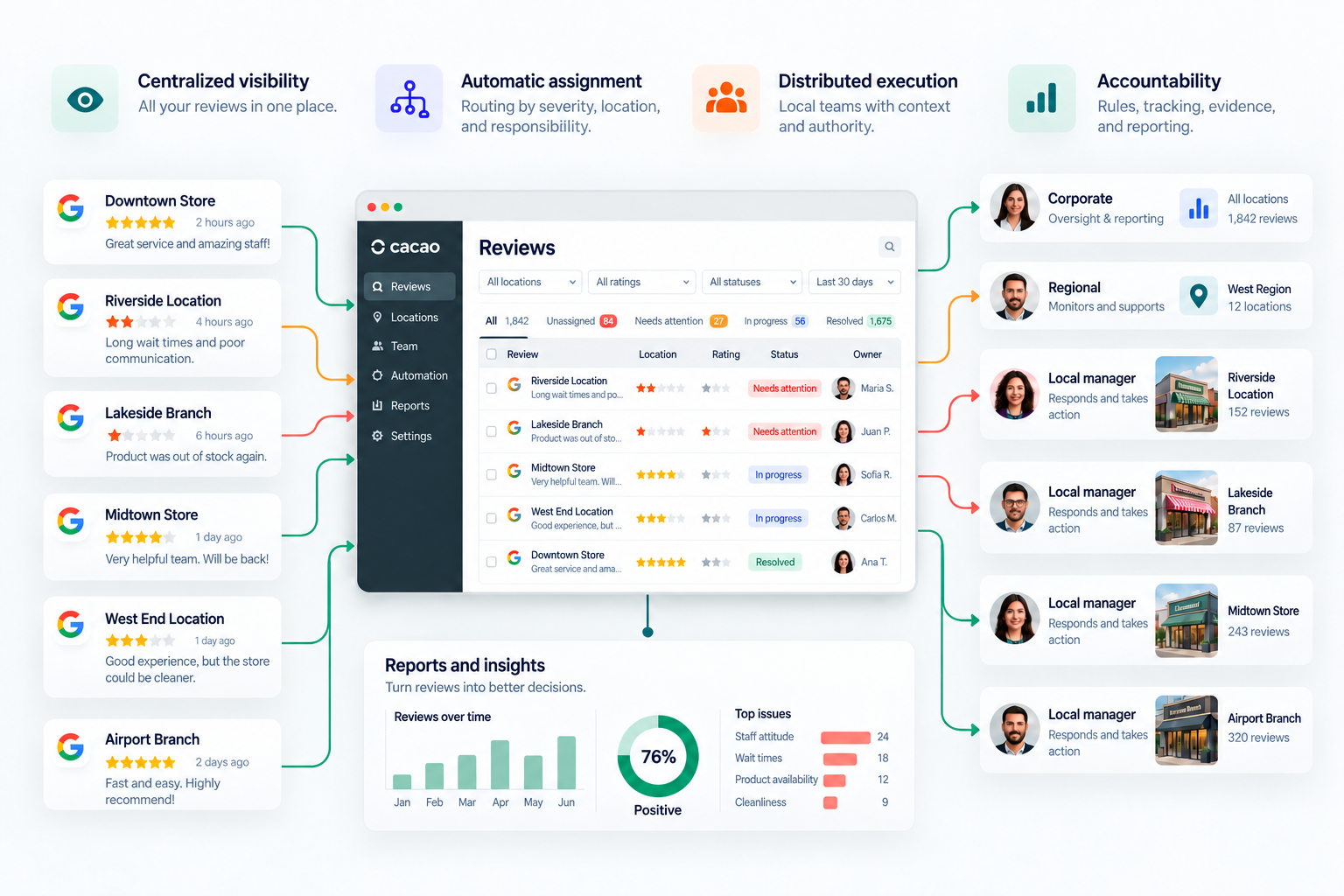

What multi-location review management actually requires
A dashboard alone does not create accountability. A workable system must make reviews visible, identify exceptions, assign an owner, support customer and operational action, and show the organization what happened.
- Centralized visibility across every connected Google Business Profile.
- Automatic routing based on severity, location hierarchy, and responsibility.
- Distributed execution by people with local context and authority.
- Corporate accountability through rules, tracking, evidence, and reporting.
Why managing every review from headquarters doesn't scale
At scale, a negative review can arrive, go unnoticed, remain unassigned, and receive no customer-recovery action. The incident stays unmanaged while the public review continues affecting the brand.
Centralizing every action at headquarters creates another failure mode: a queue that grows with the network. Reaction time slows, local facts are missing, and Corporate becomes the bottleneck.
- Inconsistent responses and slow reaction times.
- Unclear ownership between Corporate, Regional, and Local teams.
- Network averages that hide weak locations.
- Local successes and recurring problems that never become visible centrally.
Choose the right operating model
The right model depends on how much local context the work requires and how much control the brand must retain. Most large networks need a deliberate hybrid rather than either extreme.
| Model | How it works | Main tradeoff |
|---|---|---|
| Centralized | Headquarters handles most reviews and decisions. | Consistent, but slow and detached from local facts. |
| Decentralized | Each location manages its own process. | Fast locally, but inconsistent and difficult to supervise. |
| Hybrid | Corporate defines rules; assigned teams execute locally. | Scalable when ownership, permissions, and reporting are explicit. |
Define Corporate, Regional, and Local responsibilities
Responsibility can follow a nested structure such as Organization → Country → Region → Location. Access and assignments should follow the same hierarchy.
Corporate
Defines review-management standards, response policies, automation, routing rules, escalation expectations, and measurement. It retains visibility without authoring every response.
Regional
Supervises assigned groups, receives incidents or reviews, coaches locations, and routes responsibility to the correct local owner when necessary.
Local
Investigates what happened, contacts customers when appropriate, performs the required operational action, and executes review-generation practices within corporate rules.
Centralize reviews before trying to manage them
All relevant locations need to be visible in one operating view before the organization can manage exceptions consistently. Connect each Google Business Profile, then organize locations by real reporting and responsibility groups.
Use a centralized Google reviews dashboard to move from the network to a region, location, and individual review without rebuilding reports manually. Google Business Profile management remains the adjacent discipline for profile health and information.
Detect which reviews actually require attention
Detection should consider rating, severity, topic, sensitivity, and exceptions defined by Corporate. Negative reviews deserve particular attention, but the system should also reveal unusually positive local performance and recurring praise.
Alerts can help teams identify urgent feedback; deeper topic and trend investigation belongs in multi-location review analytics.
Route reviews to the right person automatically
Routing converts visibility into ownership. For example: if a review is negative and its location belongs to the Northern Region, assign the Northern Regional Manager. If it belongs to Location 37, responsibility can then move to Local Manager 37 under the organization’s rules.
- Review severity + location or group hierarchy + user responsibility = correct owner.
- Routing rules should reflect actual authority, not simply send every exception to Corporate.
- Escalation should have an owner and expectation, not just a notification.
Treat serious negative reviews as customer incidents
A serious negative review often requires work outside the public response: investigation, customer contact, operational correction, and evidence. Cacao can support custom CRM integrations so these incidents enter an organization’s existing workflow. Where implemented, ticket state and evidence can be read back for Corporate visibility.
The ideal flow is: negative review → Cacao rule → CRM ticket → responsible user → customer or operational action → evidence → ticket closed → Corporate visibility. Salesforce integration is being worked on; this is not a claim of a standard native Salesforce or HubSpot integration.
Responding to a review is not the same as resolving the incident
ACT ≠ RESPOND. A public reply can acknowledge a customer while the underlying complaint is still being investigated. Treat response management and incident management as separate, connected workflows.
Cacao response statuses
PENDING means the AI suggested or generated a response, but it has not yet been approved. RESOLVED means the response has been published to Google Business Profile. In this response workflow, RESOLVED does not mean the customer incident has been resolved.
- A negative review is operationally managed only when its associated incident or ticket is closed with evidence that the required action was performed.
- A generated, approved, or published response alone does not make the incident managed.
| Workflow | Sequence |
|---|---|
| Response management | Review → AI suggestion → human approval when required → response published on Google |
| Incident management | Negative review → detection → routing → responsible person → CRM ticket when integrated → investigation or customer contact → operational action → evidence → ticket closed → Corporate visibility |
Decide what to automate and what needs a person
Not every review needs the same path. Routine or positive reviews can be automated where appropriate; negative, sensitive, or fact-dependent reviews often need human intervention. This is not a universal rule: Corporate defines the policy, ratings, topics, approvals, and exceptions.
Detailed response configuration belongs in the guide to automated AI review responses.
Keep responses consistent without making them identical
Brand consistency means shared tone, safeguards, and instructions—not repeating one template across hundreds of locations. Cacao obtains relevant information from each connected Google Business Profile, and location or profile context can be passed as variable context to the AI prompt.
The broader governance principles are covered in the guide to brand consistency across multiple locations.
Track whether negative reviews were actually managed
Average rating and response rate are useful but insufficient. The operating system should reveal whether negative experiences received real action.
- Negative review rate = negative reviews ÷ total reviews.
- Negative-review management rate = managed negative reviews ÷ total negative reviews. Managed means the associated incident closed with evidence.
- Reaction time = how long the organization takes to act after a negative review arrives.
- Also monitor total review volume, review velocity, recurring topics, and location-level Health Score where relevant.
Compare locations without letting averages hide problems
A good network-wide rating can conceal a location with a high negative-review rate, unmanaged incidents, slow reaction times, recurring complaints, or weak review velocity. Corporate needs to drill from Network → Region → Location → Review or topic.
The same hierarchy can reveal exceptionally positive feedback and recurring strengths. Centralized visibility makes local success learnable without inventing a separate escalation workflow for praise.
Use review patterns to find operational problems
Individual reviews describe experiences; repeated topics can expose a process or people problem. Cacao has observed an anonymized case in which repeated complaints revealed an issue with how an employee was treating customers. The company investigated and took operational action.
The lesson is the sequence: reviews → pattern → operational visibility → investigation → action. Review analysis is valuable when it changes the operation, not merely when it produces a chart.
Don't ignore review generation
Management depends on a consistent flow of representative reviews. Review velocity also exposes execution gaps: several locations may generate healthy volume while others barely ask customers, a difference hidden by the network average.
Review generation is a separate discipline. Use the dedicated guide on how to get more Google reviews for acquisition tactics rather than expanding them here.
A practical multi-location review management workflow
Use the lifecycle as a continuous operating loop rather than a one-time setup.
- GENERATE — maintain a consistent flow of customer reviews.
- MONITOR — bring reviews from all relevant locations into centralized visibility.
- DETECT — identify negative, severe, sensitive, or exceptional reviews.
- ROUTE — assign responsibility using rules and organizational hierarchy.
- ACT — investigate, contact the customer, assign operational work, and record evidence.
- RESPOND — publish the appropriate Google response.
- TRACK — show Corporate and Regional teams what happened.
- ANALYZE — compare locations, rates, reaction times, topics, and performance.
- IMPROVE — change local operations and the management system, then generate again.
How the operating model changes by network type
The principles of visibility, routing, distributed execution, and accountability stay consistent. The ownership chain changes according to the relationship between the brand and each location. Each vertical page explains the commercial capabilities for that operating context.
| Network type | Central control | Distributed execution |
|---|---|---|
| Franchise networks | Brand and corporate standards | Franchisee, regional owner, and local team |
| Dealer networks | Manufacturer or brand and dealer group | Region, dealership, and local sales or service teams |
| Retail chains | Corporate | Regional owner and store manager |
| Restaurant groups | Brand or restaurant group | Area manager and each restaurant |
| Healthcare networks | Organization or clinical group | Clinic, location, or authorized team |
| Home services networks | Corporate or operating group | Branch, territory, service area, or operational team |
How Cacao supports multi-location review management
Cacao connects the operating model to daily work with centralized Google review visibility, nested location groups, role-based access, routing and automation rules, AI-assisted responses, alerts, dashboards, and custom integration capability.
See the multi-location review management software page for product capabilities. If you are choosing between vendors, use the separate guide to the best review management tools for multi-location businesses.
Frequently asked questions
How should a multi-location business manage customer reviews?
Centralize visibility, detect reviews that require attention, route them to the correct owner, separate operational action from public response, track evidence-backed closure, and compare performance by region and location.
Should Corporate respond to every review?
No. Corporate should define policies, rules, permissions, escalation, and measurement while regional and local teams execute work that requires local context.
When is a negative review considered managed?
A negative review is managed when the associated incident or ticket is closed with evidence that the required action was performed—not merely when a response is generated or published.
What does RESOLVED mean in Cacao?
In Cacao’s review-response workflow, RESOLVED means the response was published to Google Business Profile. It does not mean the underlying customer incident has been resolved.
Can every review follow the same automation rule?
It can if Corporate chooses, but most organizations differentiate by risk. Routine cases may be automated while negative, sensitive, or fact-dependent reviews receive human attention.
Build accountability without making Corporate the bottleneck
See how Cacao connects centralized visibility with regional and local execution across Google Business Profiles.
Request a demo