

Why run separate collection processes for the same customer experience?
In Cacao’s founder’s experience, collecting private feedback and requesting public reviews becomes difficult to sustain when customers face two disconnected processes.
The customer has already spent time explaining what happened. Asking them to begin another process can make the overall experience tedious. Meanwhile, local teams must remember which invitation to send, when to send it, and which branch it belongs to.
Across many locations, those differences become harder to supervise.
A connected journey lets the business pursue both objectives together:
| Objective | What the business needs |
|---|---|
| Understand the experience | Relevant survey questions and comments associated with the correct location |
| Invite a public review | A clear opportunity for the customer to continue to the branch’s Google Business Profile |
| Maintain consistency | A collection process that corporate, regional, and local teams can execute and review |
In Cacao, the survey and Google invitation belong to the same journey. Publishing on Google remains a separate action completed by the customer.
The customer’s private answers are not automatically turned into a public review.
How Cacao connects customer feedback and Google reviews
The journey begins with an invitation through a QR code, a shared link, or a message sent through an agreed integration.
1. The customer opens the invitation
The invitation gives the customer access to the Cacao survey journey after a relevant visit, purchase, appointment, or service interaction.
2. The customer identifies the branch
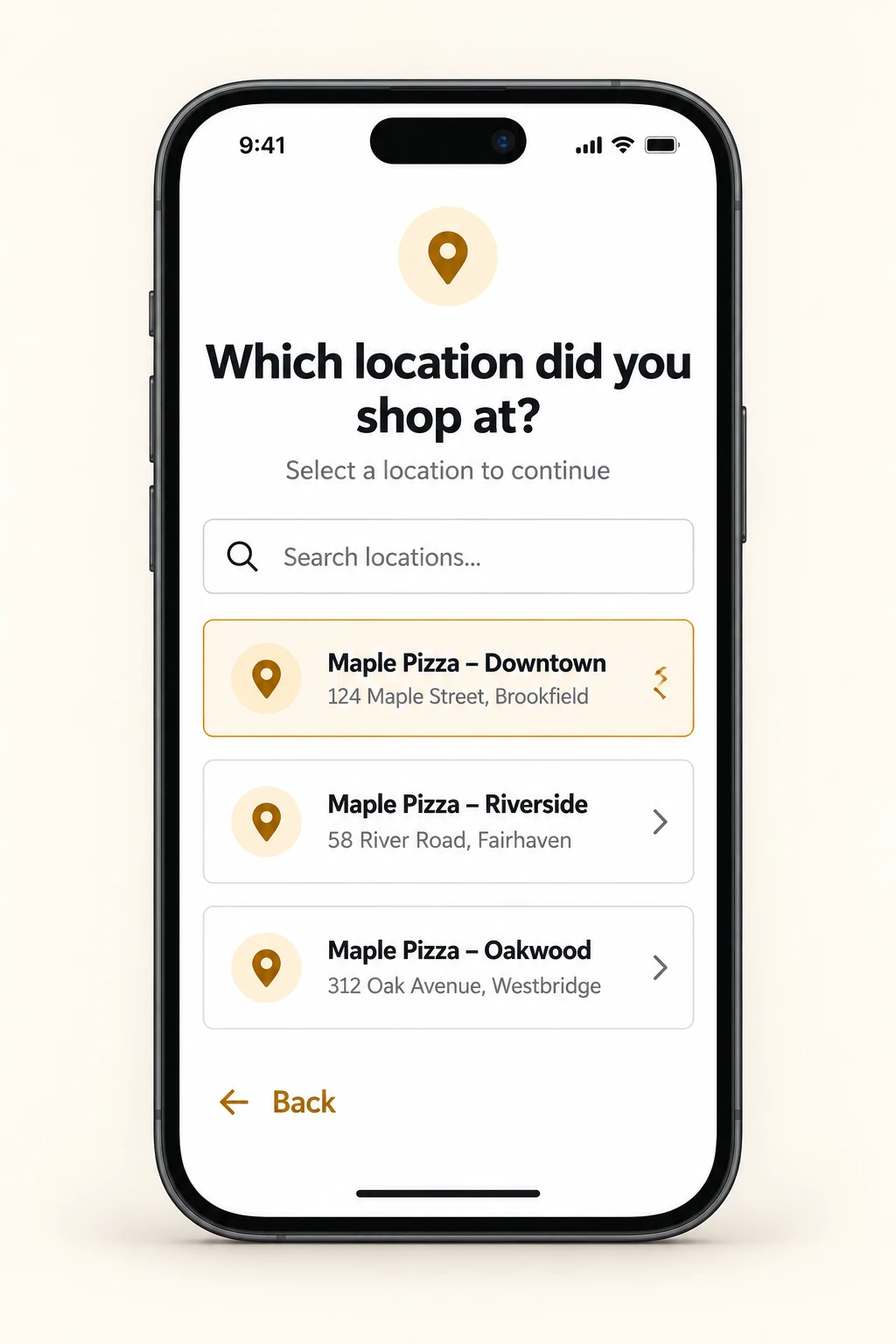
In Cacao’s geolocated flow, the browser requests permission to access the customer’s location. Cacao suggests the three closest branches, and the customer selects the one they visited.
3. The customer shares private feedback
The survey collects answers to the business’s questions. That feedback stays inside Cacao, where authorized teams can examine the experience by location and question.
4. The customer receives the Google review invitation
When the Google invitation is enabled, every survey rating receives the same invitation flow. Customers who provide negative feedback receive the same opportunity to leave a public review.
5. The customer chooses whether to publish on Google
The customer continues to the selected Google Business Profile and writes their public contribution.
Corporate can coordinate this collection process across the network while regional and local teams work with their assigned locations.
10 common problems when collecting feedback and reviews across locations
The following situations illustrate where a collection process can break down.
1. Customers face disconnected feedback and review requests
The business sends a survey through one process and requests a Google review through another. Customers encounter repeated effort, while teams struggle to sustain both activities consistently.
2. Requests depend on employees remembering to ask
Some employees ask regularly; others forget during busy shifts. Collection depends on individual habits rather than a maintained process.
3. Some branches receive steady feedback while others receive very little
A growing network total can conceal locations with limited recent feedback. Corporate needs to investigate differences in activity and execution.
4. Customers are unsure which branch to select
Nearby locations, similar names, or unclear instructions create confusion. The journey needs to help customers recognize the branch they actually visited.
5. Feedback is requested before the relevant experience is complete
A purchase, payment, appointment, and completed service can represent different stages. Asking at an unsuitable moment can produce feedback about an incomplete experience.
6. Automation is expected to work without implementation
Teams assume that connecting software is enough to trigger invitations. The source event, available data, timing, message, and delivery channel still need to be agreed.
7. Customers receive repeated or poorly timed invitations
Separate systems or teams may contact the same person. Contact rules need a clear owner and an implementation that supports them.
8. Regional differences make results difficult to compare
Countries or brands use different questions and collection methods without documenting the changes. Corporate then compares results that represent different experiences.
9. Survey completions are counted as Google reviews
A completed questionnaire is treated as evidence that the customer published a public review. The report overstates what actually happened.
10. The process is extended before it is tested
An unclear message, confusing branch selection, or incomplete location setup is repeated throughout the network. A pilot helps identify problems before wider rollout.
Define what you want to learn and what you want to grow
An integrated journey can support private learning and public review collection, but the team still needs clear objectives for each.
Start with the decisions the feedback should inform.
A restaurant group might investigate waiting times and service. A retailer might ask about checkout and store assistance. A service business might need feedback on communication and the completed job.
| Objective | Collection decision | Result to examine |
|---|---|---|
| Understand a specific part of the experience | Ask relevant survey questions | Answers and comments for those questions |
| Give customers an opportunity to review the branch publicly | Include a clear Google review invitation | Reviews published on Google |
| Improve consistency between branches | Use a shared collection process | Execution and participation differences |
| Identify locations needing support | Preserve location context and comparable periods | Branch-level feedback and underlying comments |
Keep the questionnaire focused. Each question should help the business make a decision or understand an important part of the experience.
Assign corporate, regional, and local responsibilities
A common journey needs people responsible for keeping it working.
| Team | Main responsibilities |
|---|---|
| Corporate | Defines objectives, core questions, collection standards, reporting definitions, and rollout priorities |
| Regional or brand team | Coordinates assigned locations, reviews differences, and identifies support needs |
| Local manager | Maintains collection touchpoints, trains staff, reports problems, and supplies operational context |
| Integration owner | Coordinates the source event, available data, sending process, and technical checks where automation is implemented |
Name a backup for responsibilities that must continue during absences or staff changes.
Automation can reduce repeated work, but local ownership remains important. Someone still needs to confirm that the journey fits the customer interaction and report when it stops working.
Choose the collection moment for each business type
Ask when the customer has experienced what you want them to evaluate.
These examples are starting points to test, not universal sending schedules.
| Business type | Possible collection moment | What to verify |
|---|---|---|
| Restaurant groups | Near the end of the visit or after a completed order | Whether the customer has experienced the service being evaluated |
| Retail chains | After checkout or a relevant store interaction | Whether the questions concern the store experience, the product, or both |
| Healthcare locations | After the relevant appointment or administrative interaction | Appropriate questions and handling of sensitive feedback |
| Dealership groups | After a sales or service interaction | Which department and stage of the experience the customer is evaluating |
| Home service branches | After the agreed work or service milestone is complete | Whether the customer can evaluate the completed work |
| Franchise networks | A common event adapted to the operating model | Which standards are shared and which local differences are justified |
For longer projects, an intermediate payment or appointment may not mean the customer has experienced the completed service.
Record differences between markets and business units so the results remain interpretable.
Choose how customers enter the connected journey
A network can combine on-site invitations and post-interaction requests.
| Method | When it can fit | What the team must maintain |
|---|---|---|
| QR code | Customers can provide feedback during or after an on-site interaction | Placement, readability, instructions, and destination |
| Shared link | Staff or an existing communication can provide access | Correct wording, distribution, and location selection |
| Post-interaction message | The business has a suitable source event and sending process | Available data, integration, timing, channel, and contact rules |
| A combination | Different customer journeys require different entry points | Common definitions and coordination between methods |
Test QR codes and links during an actual customer journey. Being available does not establish that customers notice or understand the invitation.
In Cacao, QR codes and links provide entry to the survey journey. Purchase-triggered invitations require a custom POS/ERP integration.
That integration defines the event, timing, message, and delivery channel.
Connect every experience to the branch the customer visited
Location context makes feedback useful to a multi-location business.
The customer’s current position, a location recorded in a transaction, and the place they visited are not necessarily the same thing.
In Cacao’s geolocated survey journey, the customer makes the final selection from the three closest branches after sharing their location. This selection also applies when the invitation comes from a custom POS/ERP integration.
Before rollout, test:
- Locations that are close to one another.
- Branch names that customers may confuse.
- Invitations opened after the customer has left the premises.
- The experience when customers do not share location information.
Confirm the actual behavior for each situation rather than assuming a fallback.
Specify automation before extending it across locations
Describe the intended workflow with the people responsible for implementation.
| Decision | Question to resolve |
|---|---|
| Event | What confirms that the relevant interaction has happened? |
| Available data | What customer and transaction information can the source system provide? |
| Message | Does the invitation clearly explain the next step? |
| Timing | When should the request arrive for this experience? |
| Channel | Which delivery method will the implementation use? |
| Location journey | How will the customer identify the branch they visited? |
| Contact rules | How will repeated invitations and relevant customer preferences be handled? |
| Technical ownership | Who investigates delivery problems and source-system changes? |
Cacao’s POS/ERP integrations are developed to fit the client operation. Confirm compatibility, sending behavior, costs, and responsibilities for the proposed setup.
Specify and verify any reminders, frequency controls, or additional sending conditions with that implementation.
Keep a common process while allowing justified local differences
Consistency does not require every branch to use identical wording or the same collection moment.
| Keep consistent | Allow appropriate adaptation |
|---|---|
| Purpose of the program | Language and locally natural wording |
| Meaning of core questions | Relevant local examples or additional questions |
| Separation of private answers and public contributions | Collection moment where the experience differs |
| Location attribution requirements | Local operational instructions |
| Reporting definitions and periods | Responsibilities within different regional or franchise structures |
| Opportunity to provide honest feedback | Customer-facing explanations suited to the interaction |
Document adaptations. When a region changes a core question or collection method, account for that change before comparing its results with the rest of the network.
Pilot the journey before rolling it out across the network
Choose locations that represent the situations the wider rollout will encounter.
For a fictional 100-location business, a pilot might include a busy branch, a lower-volume branch, two nearby locations, and a branch using a different collection channel.
| Pilot check | What to observe |
|---|---|
| Invitation access | Can the customer open the QR code or link? |
| Message clarity | Do they understand what they are being asked to do? |
| Location selection | Can they identify the branch they visited? |
| Survey experience | Are the questions relevant and understandable? |
| Google invitation | Is the public step clear and available across survey ratings? |
| Automated delivery | Does the implemented event produce the expected invitation? |
| Team ownership | Does someone know how to report and investigate a failure? |
| Reporting | Are private responses and published Google reviews counted correctly? |
Record problems and corrections before extending the process.
Include newly opened branches in the rollout plan so collection coverage stays current as the business grows.
Measure both outcomes without confusing them
The collection journey is connected. Each outcome still answers a different question.
| Measure | What it tells you | What it does not establish |
|---|---|---|
| Survey responses | How much private feedback was received | How many customers published a Google review |
| Survey question results | What respondents reported about that part of the experience | The experience of every customer |
| New Google reviews | Public review activity during the selected period | Which individual invitation caused each review |
| Differences between branches | Where execution or participation deserves investigation | The cause of the difference |
| Delivery metrics, where available | What the sending implementation recorded | Completion of every later step |
The reporting described here does not establish a reliable one-to-one match between each Cacao invitation and each published Google review.
If review volume rises after a campaign, record that observation alongside the dates and collection changes. Avoid assuming that every new review came from that campaign.
This distinction helps corporate understand both the information collected privately and the public reviews appearing at each branch.
Investigate locations receiving little feedback
A low response count is a starting point for investigation.
Consider the customer activity available for the location, then examine the collection journey.
| Possible issue | What to check |
|---|---|
| Requests are not consistently offered | Staff understanding, ownership, and execution |
| QR codes are difficult to notice or use | Placement, readability, access, and instructions |
| Invitations arrive at an unsuitable moment | The source event and sending conditions |
| Customers struggle to identify the branch | Location naming and selection |
| The questionnaire requires unnecessary effort | Relevance, wording, and number of steps |
| Automated invitations behave unexpectedly | Source events, available data, and delivery |
| Reports count different outcomes | Whether teams are comparing surveys, messages, or published reviews |
A location with fewer reviews may have lower customer activity, a different journey, or an execution problem. Counts alone do not distinguish those explanations.
Turn collected feedback into useful decisions
The connected journey gives the organization two opportunities: learn from private feedback and invite customers to contribute publicly.
The next step is to use what customers report.
Investigate recurring comments, compare locations over consistent periods, and identify who should act. Public Google reviews also require monitoring and appropriate response decisions.
Multi-location review management: responsibilities, responses, and operational follow-up
Frequently asked questions
Can customer feedback and Google review requests be part of the same journey?
Yes. Cacao connects location selection, private survey feedback, and the opportunity to continue to Google. The customer decides whether to publish a public review.
Does the customer complete one form that publishes everywhere?
No. The private survey and Google review are different submissions. Cacao connects the journey; it does not automatically publish the customer’s private answers as a Google review.
How can we maintain consistency across 100 or more locations?
Define common objectives, questions, collection standards, responsibilities, and reporting definitions. Adapt justified details locally, test the journey, and investigate differences between branches.
How can we automate requests for each business location?
Identify the customer event, available data, channel, message, timing, and location-selection journey. In Cacao, purchase-triggered invitations require a custom POS/ERP integration. QR codes and shared links support on-site entry.
Does the POS integration automatically select the branch?
No. In the collection journey described here, Cacao requests location permission, suggests the three closest branches, and asks the customer to select the location they visited.
Do customers giving negative feedback receive the Google invitation?
Yes. When the Google invitation is enabled, every survey rating receives the same invitation flow.
Can we identify which invitation produced each Google review?
The reporting described here does not establish a reliable one-to-one match. Measure private survey responses and published Google reviews separately, and confirm delivery metrics with the proposed integration.
Why do some branches receive less feedback than others?
Possible explanations include customer activity, collection timing, execution, invitation access, or customer effort. Compare equivalent periods and investigate the journey before assigning a cause.
Connect customer feedback and Google review collection across your locations
Give customers a clear journey to share their experience, keep feedback connected to the right branch, and coordinate collection across the network.
Start your 7-day free trialTalk to sales about your collection process and integration needs