
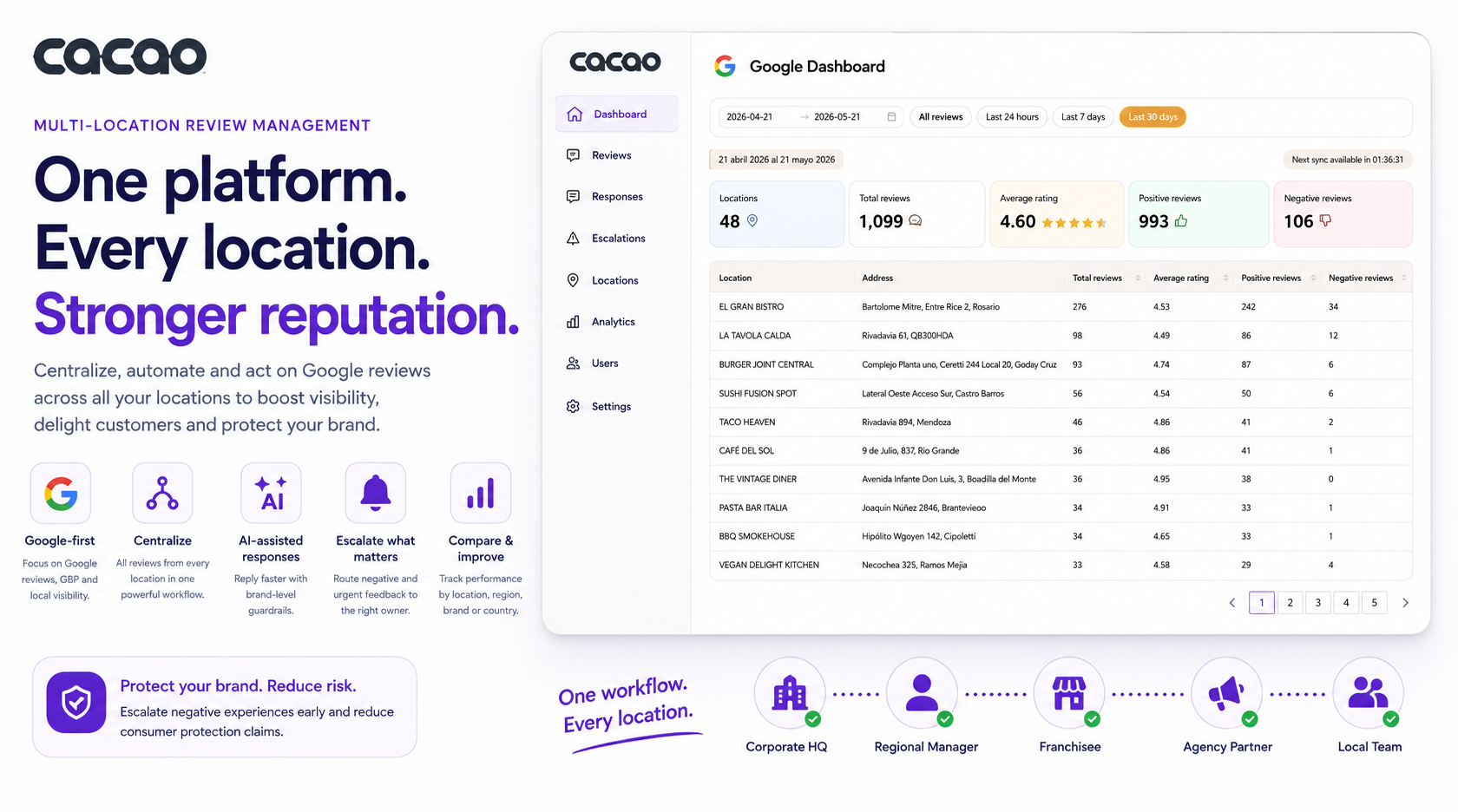

Why multi-location profile management is different
The difficulty does not grow one location at a time. More locations introduce different owners, regional teams, opening hours, categories, local services, languages, and approval paths. A change that is safe for one profile may be wrong for another.
- central teams need network-wide visibility
- regional and local teams need controlled access
- shared fields need standards
- location-specific fields need local context
- problems need to be prioritized instead of found manually
Establish ownership and governance first
Document who owns the profiles, which company-controlled Google accounts have access, and which team is accountable for routine updates, urgent issues, and local exceptions. Avoid leaving primary control in personal employee or agency accounts.
Define corporate, regional, and local responsibilities
Corporate teams can define brand standards and monitor the full network. Regional teams can supervise countries or territories. Local operators can validate the information that only they know, such as temporary hours or location-specific services.
Treat franchise governance as an operating model
Franchise networks need explicit rules for corporate oversight, franchisee access, approval, escalation, and profile ownership. The same model applies to healthcare networks, retail chains, restaurant groups, and other distributed organizations.
Connect and organize the location network
Build a complete inventory, connect the authorized profiles, and organize locations in a structure that reflects the business. Groups can represent regions, countries, territories, brands, operational divisions, or franchise groups.
- organization
- custom groups
- individual locations
Standardize core information without erasing local context
Create standards for business names, phone numbers, websites, regular hours, special hours, categories, descriptions, and attributes. Then identify which fields must remain location-specific. Consistency means governed accuracy, not copying every value to every profile.
Use bulk updates for the right changes
Bulk management should be precise. Teams may need to update an existing group, an entire region, or an arbitrary selection of locations. Review the affected profiles before publishing and preserve legitimate local exceptions.
- change special hours across a region
- update information across selected locations
- manage profiles by brand or franchise group
- apply a network-wide change without editing profiles one by one
Publish Google Posts and photos across locations
Centralized publishing helps a network coordinate campaigns. The same Google Post or image can be published across multiple locations when the content is genuinely relevant to each one. Photos should remain accurate, useful, and accessible; where supported, descriptive image alt text adds context.
Control users, roles, and Google profile permissions
Access changes as employees, agencies, franchisees, and regional managers join or leave. Review Google Business Profile users regularly, remove access that is no longer needed, and assign roles according to responsibility.
Detect incomplete, duplicate, and problematic profiles
A network view should show which profiles are incomplete and how much information is missing. It should also surface possible duplicates, suspensions, and other problematic states so the responsible team can investigate.
- Detection is not resolution: duplicate resolution happens through Google.
- Detection is not reinstatement: suspended profiles must be resolved through Google.
- Completeness is an operational signal, not an official Google score.
Measure performance by location and group
Use available Google Business Profile performance data to compare individual locations, groups, regions, and the organization. Depending on the business and data available, this can include views or impressions, searches, website clicks, calls, direction requests, bookings, messages, and other interactions.
- compare locations using the same period
- review trends over time
- use year-over-year comparisons where supported
- investigate context before treating a difference as a problem
Use profile health signals to prioritize attention
Cacao's Google Business Profile Health Score is a proprietary, explainable 0–100 location-level metric. Confirmed components include profile completeness, review velocity, and year-over-year evolution of GBP interactions.
- It is Cacao's methodology, not an official Google metric.
- It is not a confirmed Google ranking factor.
- Open the underlying signals before deciding what to fix.
Connect profile operations with Local SEO and reviews
Profile management keeps the network accurate and operational. Multi-location Local SEO addresses visibility and rankings. Review management covers the review lifecycle, while review generation, review responses, and review analytics answer separate questions.
When dedicated multi-location GBP software becomes useful
Native tools may be sufficient for a small, stable set of profiles. Dedicated software becomes more useful when teams repeatedly coordinate groups, bulk updates, publishing, permissions, issue monitoring, performance comparisons, and action queues across a large network.
Cacao is built for Google-first multi-location operations. Explore the Google Business Profile management product to see how the workflow is implemented.
Multi-location Google Business Profile management FAQs
Can you manage multiple Google Business Profiles from one place?
Yes. Google supports organizations and business groups, and multi-location platforms can add centralized editing, monitoring, publishing, permissions, and reporting workflows.
Can you update multiple Google Business Profiles at once?
Yes, supported fields can be updated across selected locations or groups. Teams should verify scope and preserve legitimate location-specific information before publishing.
How should franchises manage Google Business Profiles?
Define corporate ownership, franchisee and regional access, brand standards, local exceptions, escalation paths, and reporting before choosing tools or automating updates.
Can software resolve duplicate or suspended profiles?
Software can help detect duplicate or suspended profiles. Resolution and reinstatement must occur through Google; Cacao does not merge duplicates or reinstate suspended profiles inside the platform.
Is Google Business Profile management the same as Local SEO?
No. Profile management focuses on operating and maintaining profiles. Local SEO is the broader discipline of improving local search visibility across profiles, websites, reviews, links, and other signals.
Manage every Google Business Profile from one place
See how Cacao helps multi-location teams organize, update, publish, monitor, and measure Google Business Profiles across a large location network.
Explore GBP management