

What physical-store networks should test before choosing a platform
A retailer should test the journey from purchase or store visit to local follow-up. A shared dashboard is useful only when the review remains connected to the correct store, regional team and customer issue.
- Store routing: test nearby branches, store identifiers and the customer’s choice of location.
- Retail topics: distinguish checkout, stock availability, product advice, delivery and after-sales feedback.
- Local ownership: show which store manager and regional team can view, reply and follow up.
- Collection channels: demonstrate QR or POS/CRM-triggered requests, including the integration scope and delivery charges.
- Store comparisons: demonstrate a group overview, store comparisons, topic-level sentiment, and access to original comments. Compare equivalent periods and keep Google reviews and survey feedback separate.
- Profile changes: show how opening hours and store details are updated across the network.
Review management platform comparison for retail chains
These platforms overlap, but they do not solve the problem from the same starting point. The right shortlist depends on whether the retailer primarily needs a Google-first operating system, broad listings distribution, an enterprise customer experience suite, or review monitoring and reporting.
| Platform | Best fit | Primary approach | Bulk review operations | Important consideration |
|---|---|---|---|---|
| Cacao | Google-first retail chains and physical store networks | Enterprise Google review and reputation management with private customer surveys, requests, responses, profiles, permissions, AI sentiment analysis, and location- and group-level reporting | Centralized monitoring and individual replies at scale, with Google review comparisons and separate survey analysis, topic categories, and Excel exports | Focused on Google rather than broad multi-directory distribution; CRM integrations are developed case by case |
| Birdeye | Businesses seeking a broad reputation and customer experience platform | A wider suite that can extend beyond core review management | Confirm bulk monitoring, response automation, and approval workflows for the proposed package | Confirm which modules, channels, and services are required for the retail use case |
| Yext | Retailers that prioritize listings and digital presence consistency | Listings and digital knowledge management with review capabilities | Confirm the current review monitoring and response workflow across all required locations | May be broader than the review workflow needed by a Google-focused team |
| Reputation | Large organizations running enterprise reputation or customer experience programs | Enterprise monitoring, insights, workflows, and experience management | Confirm how bulk review operations, automation, and human oversight are configured | Evaluate implementation scope, governance requirements, and total commercial fit |
| ReviewTrackers | Multi-location teams focused on review monitoring, response, and reporting | Centralized review intelligence and location-level visibility | Confirm which bulk response and automation capabilities are included | Confirm whether listing management and review generation match the required workflow |
Cacao: Google-first retail reputation, review analytics, and reporting
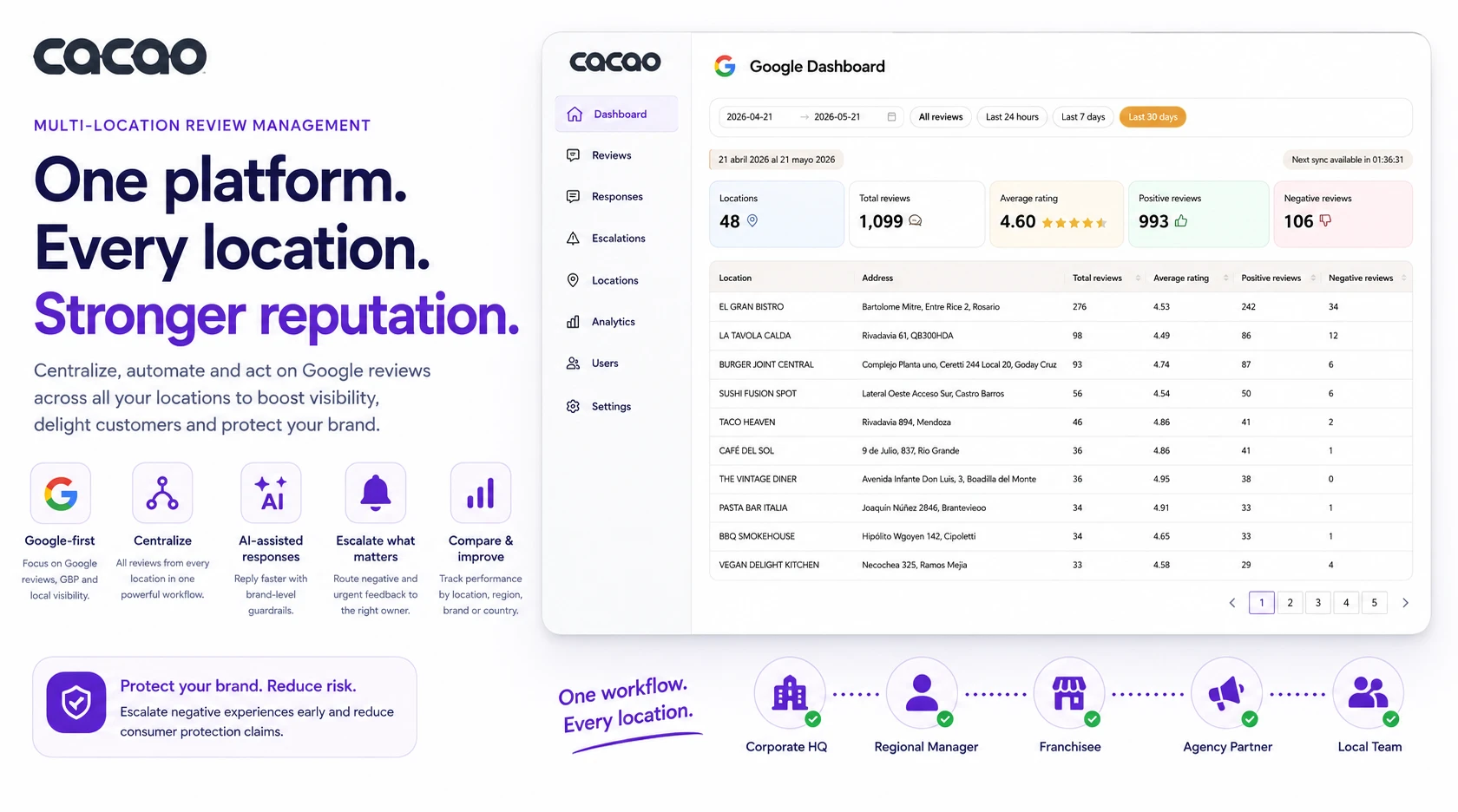
Cacao is an enterprise review and reputation management platform focused on Google. For physical store networks, it connects Google review operations and private customer surveys with location- and group-level reporting, AI sentiment analysis, and Google Business Profile management.
The platform connects Google Business Profile management with review generation, automated responses, negative review detection, role-based access, and location analytics.
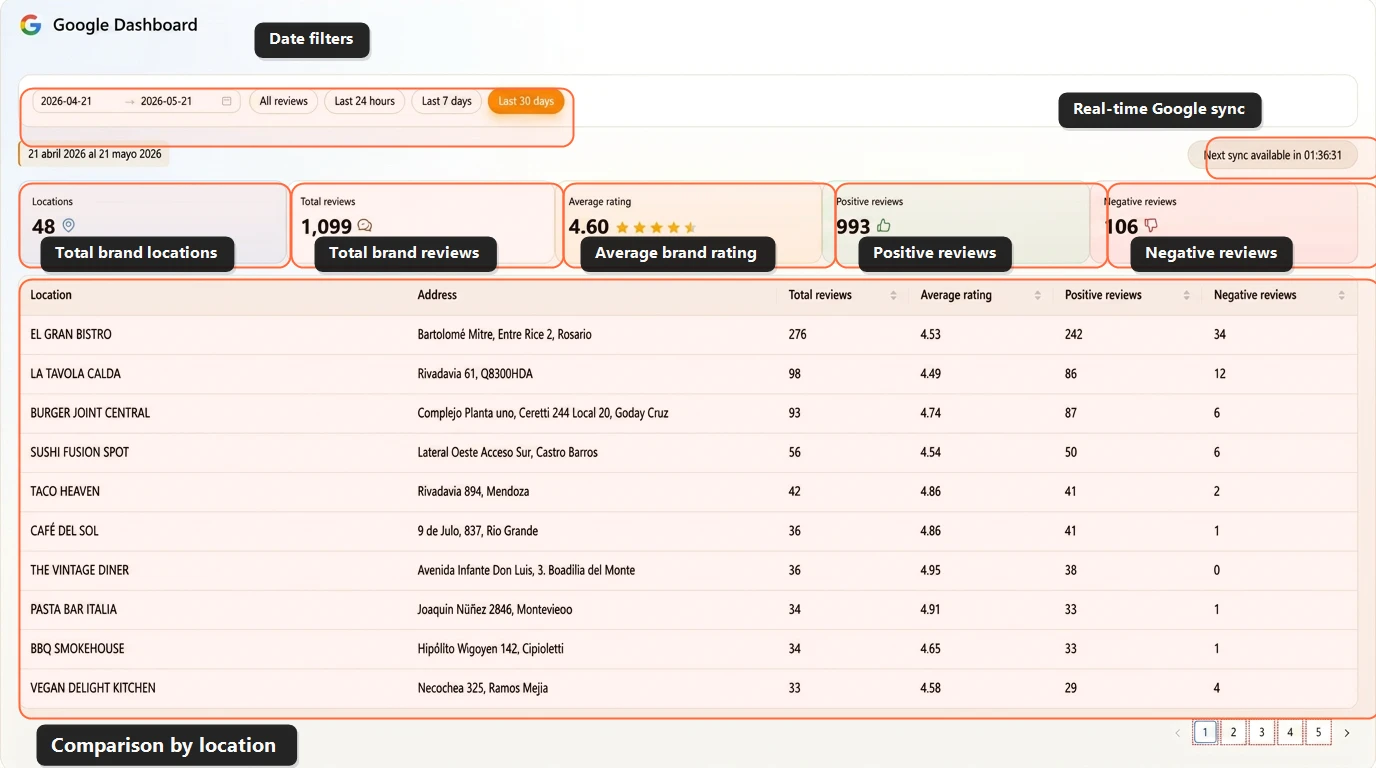
For analytics and reporting, compare historical store ratings alongside review volume and the share of 1–3-star reviews in the selected period. Move from a group overview to individual stores, topic categories, and the original comments behind a result. Explore review analytics and sentiment analysis for multi-location businesses for the analytical workflow, and location-level reporting in the Google reviews dashboard for the connected views.
Private surveys capture feedback customers may never publish on Google. Explore customer feedback software for multi-location businesses to see question ratings, written comments, and topic analysis by location. Corporate keeps network visibility while regional managers and franchisees access their assigned locations, which can include several branches. Customer-created groups can represent countries, regions, brands, or operating responsibilities; each location belongs to one group. Compare equivalent scopes and periods: Google reviews and internal surveys remain separate analytical sources, and historical ratings are distinct from period metrics.
Bulk monitoring in Cacao means bringing reviews from every connected store profile into one dashboard, where teams can identify new, negative, unanswered, and assigned reviews and analyze recurring topics or sentiment. Responses can then be published automatically at scale, while each review receives its own contextual reply rather than one generic batch response.
- Recover and centralize access to store Google Business Profiles.
- Monitor profile completeness, status, reviews, and local performance.
- Edit Google listings individually or in bulk.
- Generate reviews after purchases through multiple customer touchpoints.
- Respond automatically with AI using corporate brand parameters.
- Compare review volume and negative-review share across stores and groups using the same period; investigate praise and complaints by topic.
- Add corporate, regional, and store-level users without per-seat pricing.
- Monitor reviews in bulk across hundreds or thousands of connected store profiles.
- Automatically publish an individual, context-aware response to each review at scale.
Google-first versus multi-directory reputation management
Choosing review management software for retail businesses starts with identifying what customers are reviewing: a physical store, an online purchase, or an individual product.
For multi-location physical stores, prioritize Google review monitoring, review requests connected to the correct location, consistent responses, complaint routing, and access for corporate, regional, and store teams. Cacao's review management software for multi-location retail stores brings these workflows together with Google Business Profile management and store-level reporting.
For ecommerce and product reviews, evaluate tools built for product ratings, ecommerce integrations, and review syndication. These requirements differ from managing the reputation of physical stores.
For retailers managing several review platforms, confirm which external sites each provider supports and whether monitoring, responses, and reporting are included in the proposed plan. Cacao focuses on Google reviews and Google Business Profiles.
A Google-first retailer may prefer a focused enterprise multi-location review management platform that connects profiles, reviews, listings, automation, and analytics. Teams comparing broader local marketing suites can also use this guide to multi-location marketing platforms for review management. A retailer that must distribute business information across a large number of directories may need a broader listings platform.
Neither approach is universally better. The right choice depends on where customers actually discover the stores and which workflows the corporate team must operate every day.
How review management needs differ by retail format
Hardware and home improvement stores, furniture and mattress retailers, supermarkets and wholesalers, electronics stores, pet stores, and garden centers share a need to manage their Google reputation by location. The customer experience behind each review can differ, so compare platforms using examples from your own store format.
For hardware stores, evaluate whether the team can identify feedback about staff advice, product availability, checkout, and returns; route negative reviews to the responsible store; and keep responses consistent across branches. Review analysis can surface customer mentions of stock, but it does not establish live inventory availability.
- Furniture and mattress stores: distinguish the showroom experience from comments about delivery and after-sales service.
- Supermarkets and wholesalers: compare feedback about queues, cleanliness, pricing, and customer service between similar stores.
- Electronics stores: follow themes about product advice, purchase assistance, and after-sales support.
- Pet stores and garden centers: use store-specific context for advice, product selection, and any services actually offered at that branch.
| Evaluation question | What the platform should demonstrate |
|---|---|
| Can headquarters see the same issue across branches? | Recurring review themes with store and regional comparisons |
| Can the responsible store act? | Assigned-location access, negative-review alerts, and response controls |
| Can each reply reflect the actual experience? | Brand guidance with local context and human approval where needed |
Steren: enterprise retail review management across 800 profiles
Steren uses Cacao to operate 800 Google Business Profiles across 9 countries. The consumer electronics retailer receives and answers approximately 300 reviews per day, maintains 100% response coverage, and has an observed average end-to-end response time of approximately six minutes. Read the full Steren enterprise retail case study.
Corporate retains network-wide visibility while country and regional teams work within their assigned locations. Steren also connected and organized all 800 profiles in two days, demonstrating Cacao's ability to support enterprise-scale onboarding without removing local operating context.
Cacao and Steren are currently implementing a custom Salesforce workflow for negative reviews. The intended flow will detect a negative review, route it to the appropriate Steren user according to the organizational hierarchy, let the responsible team act, and preserve Corporate oversight. This workflow is in development and is not yet a live production capability for Steren.
Vital: a real 20-location retail workflow
Vital Supermayorista uses Cacao to manage reviews and Google Business Profiles across 20 locations. In the first month, its team answered more than 1,000 reviews through AI-generated drafts with human approval.
The same operation monitors negative reviews, compares location performance, produces reports, and updates photos, local posts, and product catalogs in bulk.
Custom CRM and API integrations for negative-review workflows
Cacao can develop custom integrations with Salesforce or a retailer's own CRM. When a negative review appears in a connected Google Business Profile, the integration can create a CRM ticket, assign it automatically according to the retailer's rules, and route it to the responsible country, region, group, or store.
The responsible user can manage the case from the CRM, including replying to the review when the configured integration supports it. As the ticket is updated, the corporate team retains visibility into ownership, actions, and resolution status. These integrations are scoped and developed case by case rather than offered as universal plug-and-play connectors.
Cacao and Steren are currently implementing this type of Salesforce workflow. It is still in development and is not yet a live production capability for Steren. See the Steren case study for the verified operating context.
- Create a CRM ticket when a negative review is detected.
- Assign ownership automatically using the retailer's organizational rules.
- Manage the review and related follow-up from the CRM.
- Give Corporate visibility into actions and ticket status.
Retail review management software checklist
Before requesting proposals, build one shared checklist for marketing, customer experience, operations, and local teams. This prevents the decision from being driven by a long feature list that does not match the actual operating model.
- Can the platform connect and organize every Google Business Profile?
- Can the corporate team identify inaccessible, suspended, duplicate, or incomplete profiles?
- Can listings be edited individually and in bulk?
- Can reviews be generated automatically after an in-store purchase?
- Can AI respond automatically using parameters established by the brand?
- Can negative feedback be filtered and managed by store or region?
- Can teams compare rating, volume, trends, calls, clicks, searches, views, and directions?
- Can global, regional, and local users receive different location access?
- Is pricing based on locations, users, modules, or a custom enterprise agreement?
- How much implementation and ongoing administration will the platform require?
- Can the platform monitor new, negative, unanswered, and assigned reviews in bulk?
- Can it respond automatically at scale while generating an individual reply for each review?
Why Cacao can be a lower-cost alternative for retail chains
Retail teams focused on Google can end up paying for channels, directories, or enterprise modules that are not central to their operation. Cacao concentrates the workflow around Google profiles, listings, reviews, generation, automated responses, negative feedback, and location analytics.
Cacao uses transparent location-based pricing rather than per-user seat pricing. Larger networks can request volume pricing through a free demo.
For budgeting 100 US stores with one Google Business Profile each, Cacao provides an indicative software example of USD 2,500 per month (USD 25 per profile), subject to a final quote. It includes taxes, unlimited users, monthly billing, and no minimum commitment. AI responses and automatic publishing, approvals, location permissions, review-generation tools, profile management, and reports are included.
WhatsApp, SMS, and email request delivery, third-party integrations such as POS or CRM connections, and project-specific services are quoted separately. This example applies only to the United States; it does not replace the published tiers or establish a rate for other network sizes or markets. Compare final proposals for the same store count, functions, integrations, and delivery volume before drawing a cost conclusion.
Cacao is especially relevant when Google is the priority and the team wants a focused alternative to a broader enterprise reputation suite. The best platform depends on the retailer's required workflow and complete quote.
Managing store reputation across multiple countries
A multi-country retail network should organize its Google presence through a clear hierarchy: a Google account connects the operation, groups organize Google Business Profiles by country, region, brand, or operating unit, and each profile represents an individual store. The retailer chooses the grouping model that matches how the business is managed.
Cacao mirrors that structure so corporate, regional, and local users see only the groups and locations assigned to them. Steren applies this model across 800 profiles in 9 countries, organizing access mainly by country outside Mexico and by region within Mexico. Explore the full Steren case study for the complete operating model.
- Group profiles by country, region, brand, or operating unit.
- Give each user access only to the groups and stores they manage.
- Avoid profiles remaining tied to former employees, agencies, or fragmented accounts.
- Keep bulk updates, reporting, and responsibility organized as teams change.
Frequently asked questions
Which retail formats does this review management comparison cover?
This comparison applies to physical store networks such as hardware and home improvement stores, furniture and mattress stores, supermarkets and wholesalers, electronics stores, pet stores, and garden centers. Evaluate Google review collection, responses, profile management, and location-level reporting against your own customer journey. For the Cacao product workflow, explore review management software for retail stores.
What software lets retail chains monitor and respond to Google reviews in bulk?
Cacao lets retail chains monitor reviews from hundreds or thousands of Google Business Profiles in one dashboard and automatically publish an individual, context-aware response to each review. Teams can identify new, negative, unanswered, and assigned reviews while organizing visibility by store, region, country, brand, or group. Cacao does not require teams to select reviews and publish one generic response as a batch; its automated workflow processes each review individually.
What is the best review management platform for multi-location retail?
The best platform depends on the retailer's operating model. This page compares retail-specific options for store networks. Cacao is a strong fit when Google reviews, listings, automated responses, review generation, location analytics, and corporate control are the main priorities. To see how the product works across a retail network, explore Cacao's retail review management software.
What features should retail review management software include?
Retail software should centralize reviews and Google profiles, detect negative feedback, support response workflows, generate reviews, compare stores, manage location data, and provide appropriate access for corporate, regional, and local users.
Can retail chains automatically respond to Google reviews?
Yes. Platforms with automated AI review responses can respond at scale while following tone and behavior parameters established by the corporate team.
How can retailers compare review performance across stores?
Use location-level reporting to move from a group overview to individual stores. Compare historical ratings, period review volume, and the share of 1–3-star reviews with their sample sizes in view. Then use AI sentiment analysis to investigate recurring topics and inspect original comments. Keep Google reviews and internal surveys separate. Google profile interactions provide additional context; these comparisons do not establish that reviews caused changes in visits or sales.
Is Google review management the same as listings management?
No. Review management focuses on generating, monitoring, responding to, and analyzing customer reviews. Listings management focuses on keeping profile information accurate, complete, and consistent. Retail chains often need both workflows connected.
Is Cacao cheaper than enterprise reputation platforms?
Cacao is positioned as a lower-cost Google-first alternative with public location-based pricing and no per-user seat charges. Buyers should still compare final proposals based on location count, required modules, implementation, and contract terms.
Does Cacao manage review sites other than Google?
Cacao is Google-first. Retailers that require broad distribution or review management across many non-Google directories should evaluate a broader enterprise platform.
What software can manage store reputation across multiple European countries?
International retailers should use software that groups stores by country, region, brand, and location; supports multilingual workflows; provides corporate, regional, and local permissions; and compares reputation performance across markets. Cacao is a strong fit when Google reviews and Business Profiles are the priority, and it offers a Data Processing Agreement for customers that require one.
Compare Cacao for your retail network
See how Cacao can centralize Google profiles, listings, reviews, automated responses, and store-level performance across your physical locations.
Request a free demo